

Cloudera’s hybrid architecture is finding renewed relevance as enterprises confront the realities of deploying artificial intelligence (AI). Sensitive data, existing infrastructure and regulatory obligations influence where AI can operate. I attended Cloudera’s EVOLVE26 event in New York on October 27, where the company outlined how it intends to address these requirements. Its Anywhere Cloud platform and expanding partner ecosystem suggest that the market has evolved toward a position Cloudera has occupied for years: Enterprises need choices about where their data and applications reside.
Cloudera’s original focus was based on commercializing Hadoop and bringing distributed processing of large datasets into enterprise computing. Founded in 2008, it went public in 2017, merged with Hadoop rival Hortonworks in January 2019 and returned to private ownership in October 2021 through an acquisition by Clayton, Dubilier & Rice and KKR. The technology has evolved significantly over this time. Its open data lakehouse uses object storage and open table formats such as Apache Iceberg, enabling multiple processing engines to work with shared data. Evaluating Cloudera solely through its Hadoop heritage misses much of its current strategy.
That heritage does explain its experience with demanding enterprise environments. Financial services and other regulated industries must manage security, auditability and business continuity alongside innovation. Public customer references include telecommunications, manufacturing, financial services and public sector organizations. Cloudera’s global reach also shows in its EVOLVE26 program, with major events in Singapore, São Paulo, New York, Washington, D.C. and Madrid. Its customers operate under varied infrastructure and jurisdictional requirements.
Cloudera announced Anywhere Cloud on August 19 in conjunction with EVOLVE in Singapore. The platform is designed to support data and AI applications across public clouds, sovereign infrastructure and on-premises environments through a common operating model. It combines self-service deployment with centralized governance and an open marketplace for Cloudera, partner and open-source services. At the time of the event, Cloudera Anywhere Cloud was in limited availability, with general availability scheduled for the end of November.
The architecture also provides a path to run new workloads alongside existing Cloudera deployments. This matters because upgrading an established data estate involves application dependencies, testing and operational approvals as well as software installation. Separating service lifecycles can reduce the scope of individual changes. Enterprises will still need to validate compatibility, support policies and governance across versions. Modularity offers flexibility, but the operational benefit depends on how well Cloudera manages those relationships.
Anywhere Cloud incorporates Data Services 2.0, which takes a modular approach to data engineering, streaming, analytics and AI. Services can evolve independently, allowing enterprises to adopt new capabilities without coordinating every change across an entire platform. Different deployments can run different versions, accommodating systems that must remain stable while other teams move ahead. For a bank with tightly controlled production systems, the ability to introduce a newer processing engine for a separate project could make modernization considerably more practical.
Two October 27 announcements extended the strategy. Cloudera Blueprints builds on its Accelerators for ML Projects (AMPs) with reusable AI solutions, including NVIDIA AI Blueprints built with NVIDIA Agent Toolkit. Planned applications span transaction foundation models for fraud detection, ambient healthcare agents, telecommunications network configuration and synthetic video detection. Bringing these workflows together with Cloudera’s data management and governance reduces the integration work needed to move from prototype to production. Buyers should verify availability for each blueprint and its required components.
Cloudera also expanded its Enterprise AI Ecosystem with Mistral AI, VAST Data, Neo4j and Cartesia. Their roles address different production requirements: model choice and sovereign inference, infrastructure to supply data to GPUs, knowledge graphs that connect business context, and voice interfaces within customer-controlled environments, respectively. I see this as a useful extension of the platform strategy. Enterprises need these capabilities to work together, and validated integrations help reduce the effort of assembling an AI environment.
In my view, the market has moved closer to Cloudera’s long-standing hybrid proposition. Data sovereignty, latency and the cost of moving large datasets can make on-premises execution a requirement. We assert that through 2028, one‑half of enterprises will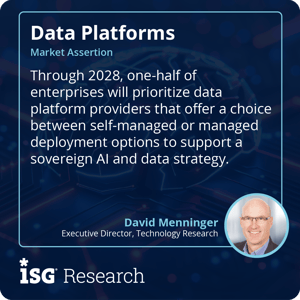 prioritize data platform providers that offer a choice between self-managed or managed deployment options to support a sovereign AI and data strategy. Enterprises that need on-premises deployments cannot satisfy that requirement with a service confined to public cloud infrastructure. Cloudera offers a relevant option, although deployment flexibility alone will not establish superior performance or lower total cost. Those outcomes require evaluation of each enterprise’s workloads.
I recommend that enterprises with substantial data estates, particularly those requiring on-premises or sovereign deployments, include Cloudera in their evaluations. Cloudera has performed well in many of our Buyers Guides and was rated Exemplary in Operational Data Platforms, Analytic Data Platforms, AI Governance and Operations and Real-time Data. Existing customers should examine how Anywhere Cloud and Data Services 2.0 can support new applications alongside established systems, beginning with a defined use case and measurable deployment, governance and cost objectives. Cloudera’s experience gives it a credible foundation. Delivering a simpler operating experience across those environments will determine how effectively it converts that experience into the next phase of growth.
Regards,
David Menninger
About the author