

Hello. This is Stanton Jones with what’s important in the IT and business services industry this week.
If someone forwarded you this briefing, consider subscribing here.
What You Need to Know
Metrics that measure AI adoption and functionality are performing better than expectations, while metrics tied to business outcomes and realized financial outcomes of AI remain below expectations. How long will it take for this to start to change?
Data Watch
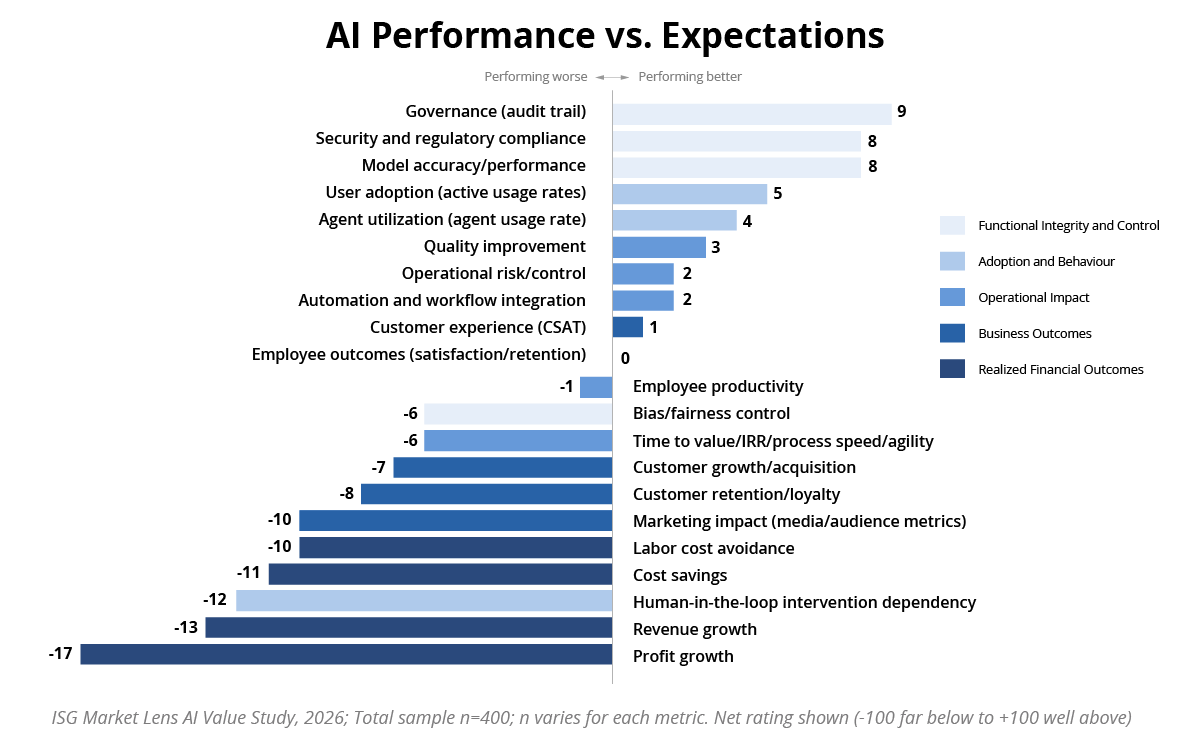
An AI Productivity Paradox?
There is a famous quote from MIT economist Robert Solow: “You can see the computer age everywhere but in the productivity statistics.” Solow was referencing the fact that, despite massive investments in computers and computer infrastructure in the 1970s and 1980s, productivity growth had slowed in the U.S.
This is often referred to as the “productivity paradox.” Massive investments are made in a transformative technology, but the expected productivity gains don’t immediately appear in the statistics. Those gains may emerge years or even decades later, after companies redesign their processes and organizations around the technology (like what happened in the early 1990s).
One could argue we’re seeing the productivity paradox play out today with AI. Hundreds of billions are being spent on AI and AI-adjacent sectors with the expectation of massive productivity improvements. But, to date, enterprises are indicating productivity metrics (as well as other operational, business and financial metrics) are not performing as well as expected.
We’re drawing this conclusion from our recent research on how, and if, companies are realizing value from their AI investments. For example, we asked respondents what metrics they are using to measure AI value, what their expectations are for those metrics, and finally, how those metrics are performing against said expectations.
We then categorized those metrics according to a framework we use to measure value, using five types of measurements, including functional metrics (for example, model performance), operational impact metrics (for example, productivity) and realized financial outcomes (for example, profit growth).
And, as you can see in this week’s Data Watch, metrics that measure business outcomes and financial impact are underperforming against expectations. Meanwhile, adoption and functional metrics are largely outperforming expectations.
For those of you who have read Alex’s and my work for a while now, you may recall that we showed a very similar set of results to this back in the second half of 2025. What we found was that business and realized financial savings metrics were underperforming while functional and adoption metrics were overperforming.
What’s going on? Isn’t AI supposed to supercharge all of this?
There’s a paper written by another academic, Stanford economist Paul David titled “The Dynamo and the Computer: An Historical Perspective on the Modern Productivity Paradox.” It’s a long title but a relatively short read.
David writes about how electrification of factories started around the mid-1890s, but the expected productivity gains in manufacturing didn’t start to improve until the early 1920s. That’s because early retrofits usually relied on adding electric motors to plants that still relied on steam-powered shafts. The productivity gains that eventually emerged almost 30 years later were from redesigning the factory, the processes and people around the new technology.
Does this sound familiar?
In our view, most enterprises are looking at a multi-year AI transformation. Data, platforms, processes, workforces, decision rights and partners will need to be analyzed and redesigned with models at the core, not just bolted on to yesterday’s operating model.
That is going to take time. How long? History suggests it could take a while.
About the author