

Hello. This is Stanton Jones with what’s important in the IT and business services industry this week.
If someone forwarded you this briefing, consider subscribing here.
What You Need to Know
Enterprises are investing in infrastructure to support AI – and to defend against it.
Data Watch
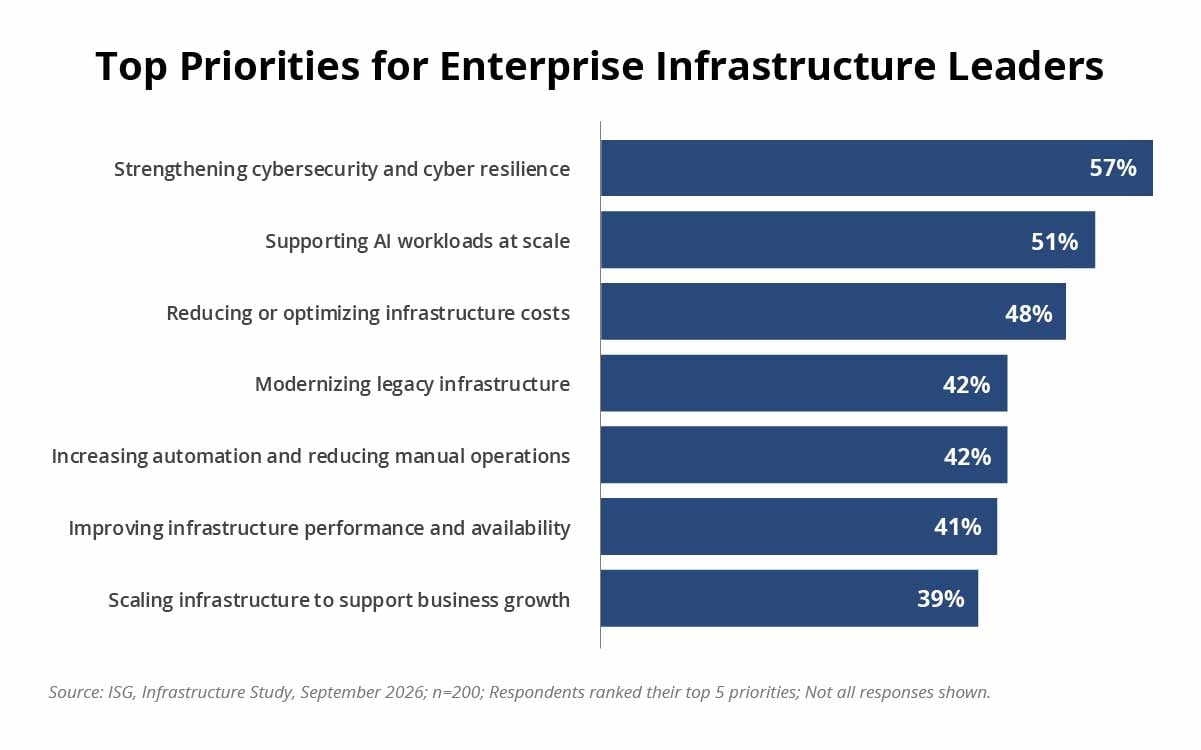
As my colleague Alex Bakker wrote a few weeks ago, “CISOs were worried AI would be their enemy before it was their friend. It’s fair to say that now it’s both.” We are seeing signs of that “frenemy” mindset in our most recent study on the state of enterprise infrastructure.
As you can see in this week’s Data Watch, enterprise infrastructure leaders are trying to juggle two priorities: protecting their systems from new autonomous AI threats from the outside and ensuring their systems are ready to support an explosion of new AI workloads on the inside.
The Details
- 57% of respondents rank increasing cybersecurity and cyber resilience in their top five priorities.
- 51% of respondents indicate that supporting AI workloads at scale is a top-five priority.
- Nearly half of respondents rank reducing infrastructure costs in their top five priorities.
Funding the Frenemy
This study was conducted in September. Given what’s transpired over the past few weeks in the realm of cybersecurity, it’s safe to assume that strengthening cybersecurity and cyber resilience remains a top – or the top – priority for infrastructure leaders.
As an example of what infrastructure leaders are facing today, look at what the U.S. Federal Bureau of Investigation published last week about ARTEX, an open-source platform that is – under normal circumstances – used to test security. The agency says that “threat actors have weaponized [ARTEX] to automate multiple phases of cyber intrusions at machine speed, from reconnaissance through data exfiltration.”
So, enterprise infrastructure and security leaders are now faced with a threat from AI that comes at them at a speed and scale that was unthinkable a year ago. At the same time, they are expected to support the explosion of growth in AI workloads at their own firms, with the goal of creating savings, increasing productivity and driving growth.
And, of course, they must do all of this on a largely flat IT budget.
This is one of the key reasons we see diverging growth across the tech sector. As we discussed on the Q3 Index call, growth in annual contract value in cloud infrastructure has been off the charts. IaaS contract value is up 85% year to date, much of that driven by enterprise demand for AI. But, at the same time, infrastructure managed services is up just 1% over the same time period.
Why? Because companies are using managed services to reduce costs (the third priority above) and using those savings to fund two other priorities: cybersecurity and AI.
About the author