


Banks must always rethink how they can improve business performance and compete more effectively. AI is supercharging that – changing which capabilities banks need to control, how they work with providers and what it takes to realize measurable value.
For most banks, the objective of transformation is not technology deployment, AI adoption or even productivity improvement in isolation. It is measurable improvement in the performance of the institution. Technology creates capability; adoption puts it to work; operational change creates the potential for value; and disciplined benefit capture turns that potential into business and financial results.
The Evolving Regional Bank Transformation Agenda:
The following five interconnected forces are shaping how regional banks pursue transformation and realize business value:
- Strategic pressures: Regional banks face converging competitive, financial, regulatory and technology pressures that demand a broader transformation agenda.
- Defining business value: Transformation success is increasingly measured by operational improvements and realized business and financial outcomes, not technology deployment on its own.
- AI as an accelerant: AI expands transformation opportunities, but realizing its potential depends on complementary technology, data, governance and operating capabilities.
- Strategic control: Banks must determine which capabilities are critical to their competitive advantage and how to combine internal strengths with external expertise.
- Evolving provider value: Providers must move beyond implementation and delivery capacity to offer differentiated capabilities, integrate into the bank's operating model and demonstrate contributions to business outcomes.
1. Strategic Pressures Facing Regional Banks
Especially for smaller and regional banks, many strategic pressures are converging at once. They must compete for deposits, lending relationships and payments flows while meeting customer expectations shaped by fintech innovation and the substantial digital investments of larger institutions. Their challenge is to deliver competitive capabilities without replicating the scale or cost structures of larger banks. Fraud and cyber threats continue to evolve. Regulatory expectations are increasing, particularly around AI, data and model governance. Talent remains constrained. And industry consolidation adds another layer of complexity as institutions integrate acquisitions, platforms and operating models.
AI enters the scene when banks already have a crowded transformation agenda. Banks must discern where AI can materially advance the business outcomes they are already pursuing.
Bank Transformation Starts with Business Pressure, Not Technology
|
Transformation Domain |
Regional Bank Pressure |
Strategic Response |
|
Core Platform |
Rising technology costs, legacy systems, profitability pressure |
Modernize core platforms to reduce operating costs, improve agility and support new products |
|
Data & Cloud |
Efficiency ratio pressure, AI readiness, regulatory expectations |
Build modern data foundations and cloud platforms to improve analytics, automation and governance |
|
Payments |
Fintechs winning share, changing customer expectations |
Invest in real-time payments, ISO 20022 and modern payment capabilities to remain competitive. |
|
AI & Automation |
Efficiency ratio, labor costs, productivity demands |
Deploy assistants, agents and intelligent automation to improve productivity and customer experience |
|
Fraud & Cyber |
Fraud tactics continue to evolve |
Strengthen fraud detection, cybersecurity and real-time monitoring using AI-enabled controls |
|
Customer Channels |
Fintech competition, customer expectations |
Enhance digital channels while optimizing branch networks to improve acquisition and retention |
|
Operations |
Margin pressure, efficiency ratio |
Automate workflows, document processing and servicing to lower operating expenses |
|
Governance |
Regulators increasing scrutiny of AI and models |
Establish AI governance, model risk management and robust control frameworks |
|
Providers |
Rising technology costs, vendor consolidation |
Rationalize vendors, leverage strategic partnerships and optimize sourcing to control costs |
|
Operating Model |
Industry consolidation, M&A, talent shortages |
Adapt organizational structures, integrate acquisitions effectively and build skills for a digital-first bank |
2. Transformation Success Through Business Value
Regional banks have no shortage of transformation activity. The harder question is whether that activity is producing value for the business.
That distinction matters because transformation programs are often measured first by what can be observed most easily: a platform goes live, applications are migrated, employees adopt a new tool, models move into production or customers begin using a new digital capability. These are important milestones. But they primarily demonstrate that change has occurred, not that the change has improved the performance of the bank.
ISG conducted a market scan of publicly available data and statements made by U.S. regional banks about their achievements with their AI or tech services. We then placed them on our transformation value ladder. The below table includes the definitions of each of the rungs of the ladder and gives an example of a bank performing the capabilities of that rung.
The Transformation Value Ladder: From Technology Deployment to Financial Impact
|
Level |
Description |
Example |
|
L1 – Tech |
The capability is live and functioning |
Commerce Bank (Zelle): real time, person-to-person payments are live in the channel |
|
L2 – People |
Employees or customers adopt the capability |
PenFed (Member Portal): All 2.8 million members are on the new portal |
|
L3 – Operations |
Cycle times decline, errors decrease, decisions become faster, productivity improves or customer interactions change |
Zions (TCS BaNCS): Products on the new core are delivered 20% faster |
|
L4 – Business |
Customer acquisition, retention, approvals, deposits, fraud outcomes or other business measures improve |
SECU (Service Routing): 94% member satisfaction; wait times cut |
|
L5 – Financial |
Revenue increases, costs decline, losses are avoided, deposits grow or another financially measurable benefit is realized. |
Webster (interLINK): Core deposits increased $5.7 billion at minimal cost |
The question for banks is not simply whether a new capability can be deployed, but what operational change it will enable, how that change will improve business performance and whether the resulting business value can be captured.
Defining that value path should precede decisions about which technologies, including AI, deserve investment.
3. AI Expands the Transformation Opportunity
AI unquestionably changes what is possible. It can automate work, improve decision making, make data more accessible, enhance customer interactions and allow institutions to create new capabilities faster. Once a regional bank defines the business outcomes it needs to improve, AI materially expands the range of possible responses.
ISG Market Scan of AI Value in Banking
-
We looked at publicly available statements from 77 financial institutions: regional and mid-size banks, super-regionals and 18 credit unions, read on a common public-record basis
-
Of these 77 institutions, 1,345 identified transformation initiatives, 1,276 carry public statements attributable to the initiative as a U.S. cohort result and are read for value depth
-
68 of the banks reported business-or-financial results, of which 39 state financial value, across 38 institutions
-
Generic company financial results and parent-group results never count as U.S cohort transformation value
Data from our market scan of U.S. regional banking institutions indicate transformation is occurring through a mixed portfolio of core conversions, cloud migrations, data foundations, payments modernization, digital-channel redesign, credit and deposit decisioning, fraud and financial-crime capabilities, workflow automation, governance, provider changes and merger integration.
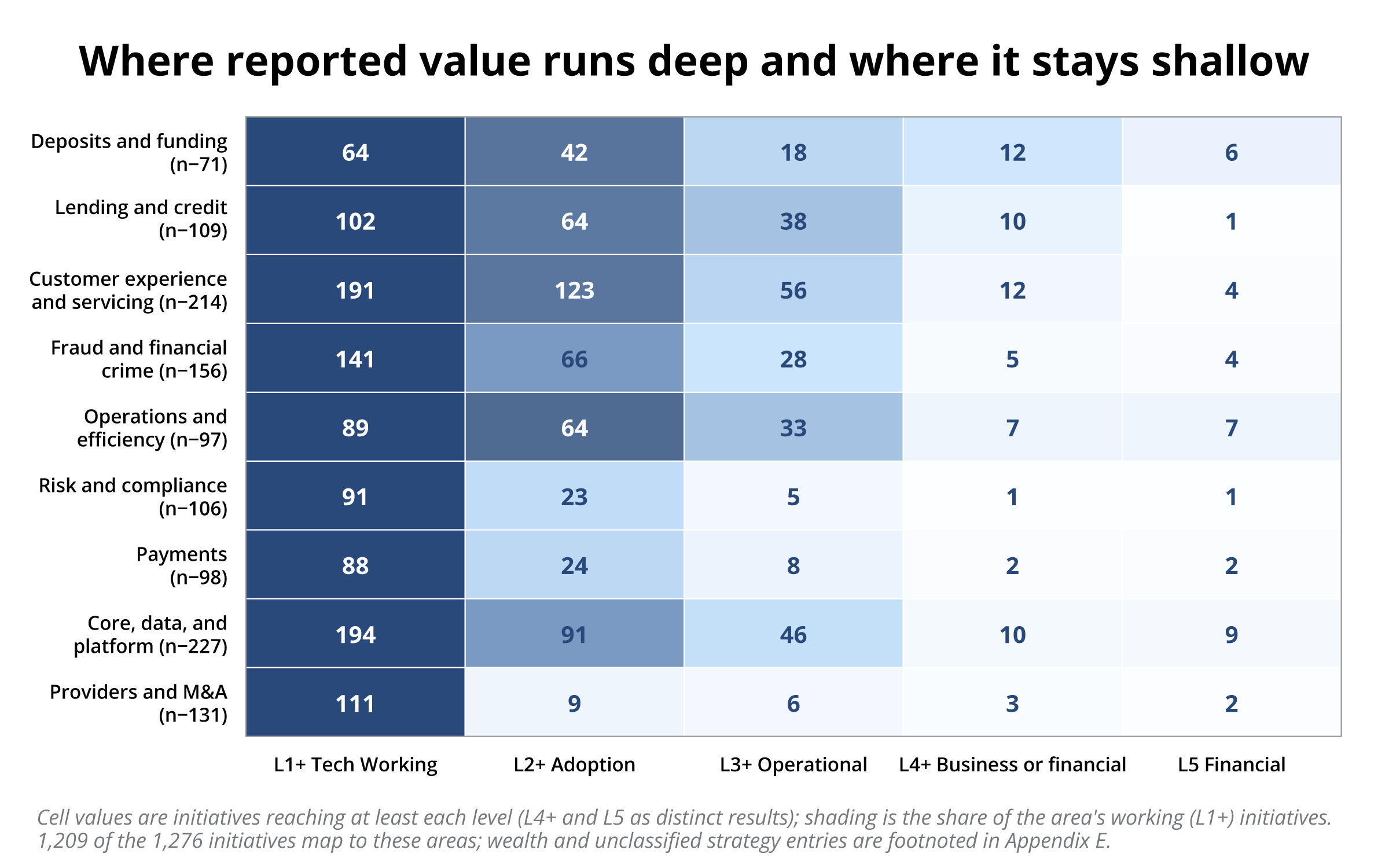
Reported business and financial results vary significantly across banking activities. Deposits and funding show relatively strong evidence of business and financial outcomes, while customer experience and core modernization account for substantial activity but fewer reported results at the highest value levels. Fraud, risk and compliance also show limited publicly reported business outcomes, reflecting both the difficulty of demonstrating value and the nature of the measures involved.
The broader finding is that transformation activity is widespread, but publicly reported evidence of realized business and financial value remains comparatively limited.
Fraud is an illustration of the challenge of progressing from operational improvement (L3) to measurable business outcomes (L4). Of the 141 fraud and financial crime initiatives reporting functioning technology, 28 demonstrate operational improvements, but only five report business or financial outcomes. Deploying AI-enabled fraud detection may improve monitoring, decision speed and alert accuracy, but demonstrating business value requires evidence that these improvements reduce fraud losses, lower false positives or minimize customer friction. Achieving those outcomes often depends on integrating real-time data, machine-learning decisioning, payments systems, model governance and operational processes. The challenge is not simply making the technology work but demonstrating that it materially improves the bank's performance.
4. Business Value Is Redefining What Regional Banks Control
As technology becomes more deeply embedded in business operations, regional banks must decide which capabilities are critical to their competitive advantage and which can be sourced externally. This increases the importance of retaining strategic control over critical data, decision rights, architecture and the capabilities that differentiate the bank.
As one chief architect at a major regional bank observed:
“To really own our destiny in a digital native world, we needed to own the IP, own the smarts, own the talent.”
But strategic control does not require building or operating everything internally. AI-enabled transformation depends on a combination of technology, data, integration, process redesign and governance capabilities that may reside within the bank or be provided externally. The following examples illustrate the complementary capabilities required to turn AI-enabled opportunities into business value.
AI-Enabled Transformation Depends on a Broader Set of Capabilities
|
Business Objective |
Potential Value Opportunity |
AI-enabled Capabilities |
Other Capabilities Required |
|
Improve financial performance |
Improve deposit economics |
Pricing intelligence, campaign targeting |
Data foundation, product capabilities, channels, measurement |
|
Compete more effectively |
Improve customer service |
Conversational AI, personalization |
Core integration, workflow redesign, escalation, customer data |
|
Manage risk |
Reduce fraud losses |
Real-time ML decisioning |
Payments integration, monitoring, governance, case management |
|
Adapt the organization |
Improve productivity |
Copilots, agents, document automation |
Workflow redesign, data access, security, change management |
As AI becomes embedded in business operations, regional banks must distinguish between accountability for business outcomes and responsibility for delivering the capabilities that enable them. Banks retain accountability for strategic decisions, risk management and realized business value, while providers contribute specialized technology, expertise and execution capabilities. The opportunity lies in integrating these contributions within the bank's operating and governance model, with clear responsibilities and measurable performance expectations for each party.
5. Provider Value Must Evolve with the Client Operating Model
As banks become more deliberate about the capabilities they control, expectations of external providers are changing. Technology platforms, implementation expertise and delivery capacity remain important, but differentiation increasingly depends on specialized capabilities, integration into the bank's operating environment and measurable contributions to business outcomes.
AI accelerates this shift by changing the economics of routine execution while increasing demand for expertise in data, integration, governance and continuous optimization.
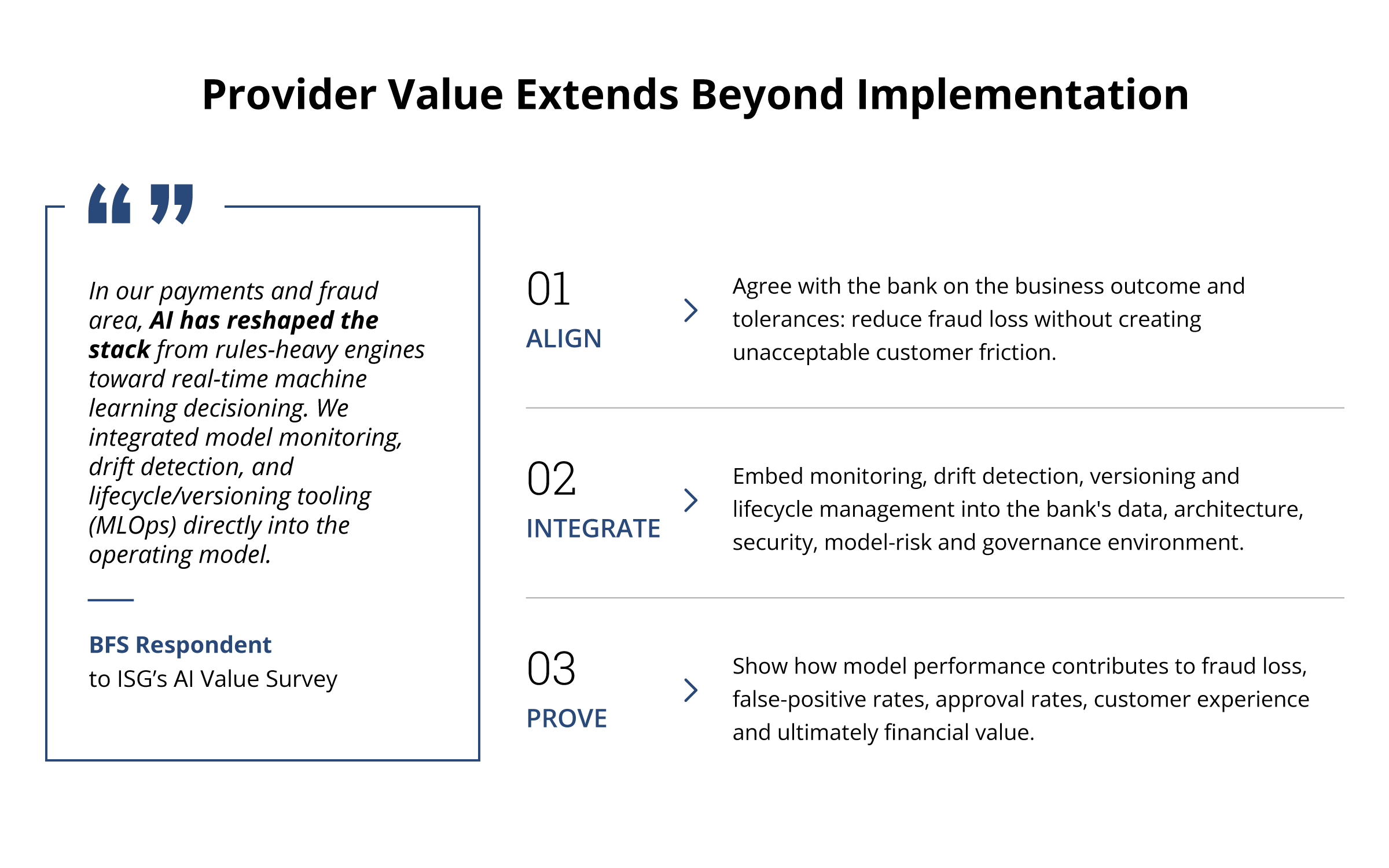
Again, using the fraud example a bank may retain control over its fraud strategy, risk appetite, decision policies and customer experience while relying on providers for machine-learning technology, payments integration, model monitoring and specialist expertise. The provider's role extends beyond implementation to supporting continuous improvement in fraud detection, false positives and decision performance.
The bank remains accountable for business outcomes, while providers are responsible for their contributions within the bank's broader operating and governance environment. This requires closer collaboration, greater transparency and shared performance measures.
For regional banks, the opportunity is to combine strategic control with differentiated external capabilities. For providers, it is to become more integral to how banks create and realize value.
The Ultimate Measurement Is Business Performance
Regional banks face a transformation challenge that extends well beyond AI. Competitive pressures, rising costs and changing customer expectations require institutions to modernize technology, improve operating performance and strengthen the capabilities that differentiate them.
AI expands what is possible, but technology adoption alone does not create competitive advantage. The evidence from ISG's research underscores the importance of moving beyond implementation and adoption to operational improvements, measurable business outcomes and financial value.
Success increasingly depends on how effectively banks combine their institutional knowledge, customer relationships and strategic control with the technology, expertise and capabilities available through external providers. For providers, this raises expectations to contribute differentiated capabilities that integrate into the bank's operating model and support continuous value realization.
Ultimately, the competitive advantage will not come from how extensively regional banks deploy AI, but from how effectively they turn AI-enabled transformation into measurable improvements in business performance.
About the Research
This paper draws on ISG's 2026 study, Banking: From Transformation to P&L, which examined publicly reported transformation activity across 77 U.S. regional and mid-size banks, super-regional banks and credit unions between 2023 and mid-2026.
The research identified 1,345 transformation records spanning AI, technology modernization and business strategy. Following source validation, attribution checks and exclusions, 1,276 transformation-attributed initiatives were analyzed using ISG's five-level Value Evidence Ladder, which distinguishes technology deployment (L1), adoption (L2), operational improvement (L3), business outcomes (L4) and financial value (L5).
The analysis draws on institutional disclosures, executive statements, provider reports, industry publications and regulatory filings. Reported results were checked against source text, classified by their deepest demonstrated level of value and adjusted to exclude duplicate records, unsupported transformation attribution and results attributable only to parent organizations.
The study measures publicly reported evidence of transformation value not independently verified performance. Limited disclosure should not be interpreted as an absence of business value, and differences in reporting practices may influence the findings.
Please fill out this form to continue.
About the authors

Marc Harrison