

Hello. This is Alex Bakker with what’s important in the IT and business services industry this week.
If someone forwarded you this briefing, consider subscribing here.
Field Services
AI is compressing the cost of knowledge work across IT services. But whether the domain is application development, infrastructure management, network operations or BPO, the commercial assumption is that IT services providers need to commit to savings as a part of almost every deal.
At the same time, AI has made a lot of the technology conversation around physical hardware again for the first time in years. The industry is talking about GPUs and servers, but also power generation, cooling, data-center construction and all the other physical infrastructure required to support new AI capacity. That is only one end of a much larger physical technology estate. Enterprises are also adding sensors and connected equipment to factories, instrumenting retail stores and other operating locations, deploying edge infrastructure and continuing to install and refresh workplace and network technology. Our latest ISG Market Lens Field Services Study covers this entire spectrum, from project deployments and workplace technology to OT, device lifecycle, servers, networks and desk-side support. Field services is, in a sense, the work required when digital investment becomes physical reality.
Data Watch
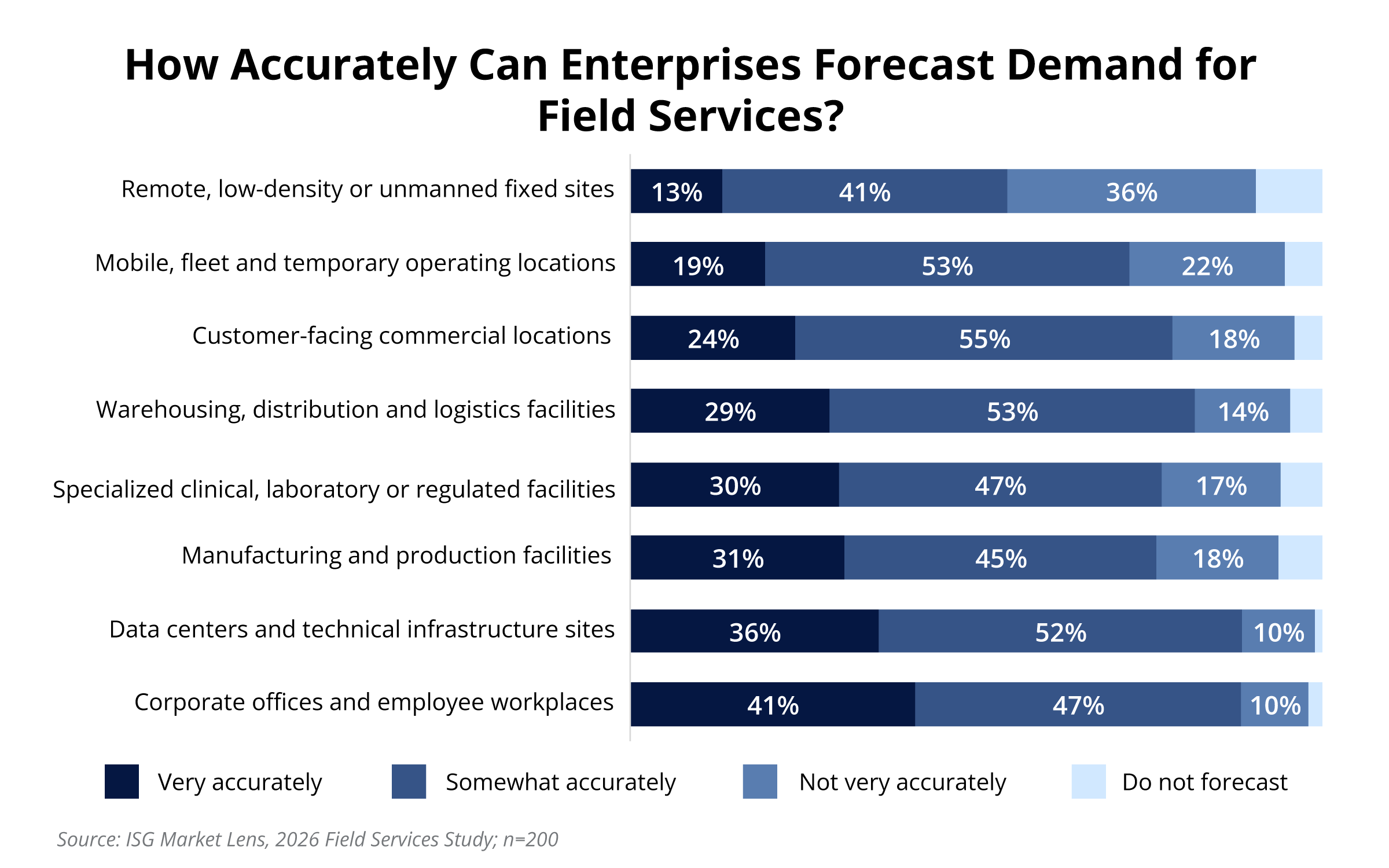
One of the most interesting results in our study is how little visibility enterprises have into the demand for field services technician capacity (See Data Watch). As the chart shows, even in corporate offices and employee workplaces, the most predictable environment we studied, only 41% of respondents characterized their forecasts of field services demand and required technician capacity as “very accurate;” every other environment was lower.
Some of that work is obviously predictable. Enterprises know when they intend to open a new location, refresh a fleet of devices or deploy new equipment. But field services also includes a long tail of maintenance, incidents and tasks for which organizations may have a reasonable expectation of overall volume without much visibility into exactly what will happen, where it will happen or when. A company may know roughly how many support incidents it will experience during a year without knowing when a conference room will stop working, when an access point will fail, when a component in a data center will break or when a sensor in a factory will be accidentally hit with a forklift.
The most important takeaway from this data is that it doesn’t reflect a failure to plan or model the environment. A lot of the time, it simply reflects the randomness of the physical world. Enterprises have spent decades making technology more reliable, standardizing equipment, automating processes and enabling remote support, so the work that remains is often there precisely because it has resisted those efforts. Ultimately, our study shows that AI is likely to improve triage, make technicians more productive and allow some additional incidents to be resolved remotely, but those improvements are expected to be small. Enterprises ultimately expect demand for field services through 2028 to remain flat or to increase across the operating environments we studied.
For IT services providers, this creates an interesting contrast with the rest of the market. Our study indicates that much of this work remains fragmented because enterprises organize the work around the technology being supported: OT may be managed at the factory level, data-center field services through infrastructure, workplace support somewhere else, with OEM agreements, regional specialists, contractors and subcontractors distributed across all of them. Yet the enterprises in our study increasingly recognize the common requirement underneath that fragmentation. Seventy percent say subcontractors are essential to delivering field services at global scale, while 57% agree that the future is service orchestration rather than technician ownership.
Enterprises’ financial expectations for these provider relationships also support the idea that orchestration of outcomes is more important than pure cost management. Seventy-six percent say that, for critical physical technology, the cost of downtime matters more than the cost of the technician visit, while 65% say first-time fix is a more meaningful economic measure than cost per dispatch. In a very real sense, nobody is negotiating very hard over the hourly rate of a technician who can solve a sufficiently expensive problem; what matters is whether the required capability can be brought to the right place, with the right materials, at the right time.
That suggests a category-creation opportunity for services providers. Rather than treating workplace, data center, network, OT and other physical technology support as unrelated pockets of labor, providers can treat them as broader requirements for technical capacity that need to be orchestrated across regions, tasks, domains and subcontractors, with a common layer of governance and service levels. On average, the companies in our study already spend about $21 million annually on field services, which means there is opportunity to aggregate a substantial amount of existing, fragmented demand into a larger managed-services contract.
As the IT services industry considers how AI compresses prices or volumes for many ITO and BPO domains, field services seems largely shielded from that compression at present. AI will certainly change how this work is coordinated and performed, but demand for AI itself is increasing the investment in a larger physical technology estate, while the work required to build and support that estate remains difficult to predict or eliminate.
About the author