

The future of work just changed — again!
For the past five years, the conversation about the future of work has moved in waves. From where work happens – remote, hybrid, distributed teams – to how work gets done — collaboration platforms, digital workplaces, automation and more. Since the end of 2024, the focus has shifted to the role of generative AI, with personalized copilots promising productivity gains across every function.
But a quieter, more consequential shift is now underway. Artificial intelligence (AI) is moving beyond assistance and is beginning to act. We have entered the era of agentic AI — systems that do not simply generate content or summarize information but that can interpret goals, make bounded decisions, coordinate across systems and execute actions within defined guardrails. We now have the potential for a blended workforce of humans and AI agents.
Designing this model requires more than deploying tools. Most enterprises are experimenting with agents but very few are structurally prepared for what agents can achieve. Enterprises need to redesign themselves so they can operate safely, coherently and competitively in a world where execution itself is partially autonomous.
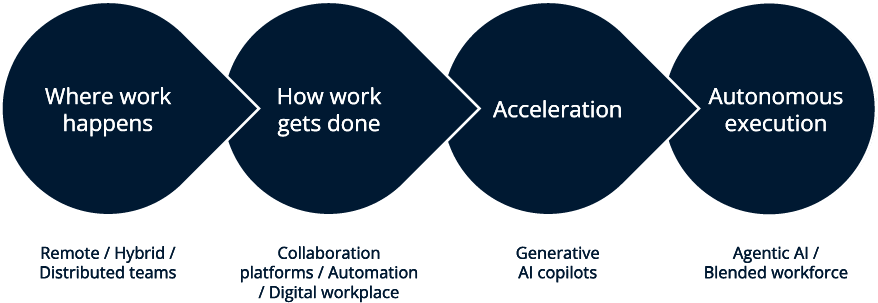
Figure 1: The Conversation about the Future of Work Is Changing
The Gap Between Excitement and Reality
Enthusiasm for agentic AI is real and, in many organizations, intense. Major enterprise software providers spent much of 2025 embedding agentic capabilities directly into their core platforms — not as optional add-ons, but as central features. ServiceNow launched its AI Agent Orchestrator in 2025 alongside thousands of pre-configured agents spanning IT, HR and customer service. Workday restructured 8.5% of its global workforce, in part, to redeploy investment toward AI development. These moves signal that the vendor ecosystem has already made its bet.
Yet the picture inside enterprises tells a more complicated story. According to ISG's State of Agentic AI Market report, 43% of agentic systems in production today are simple model-based agents, which are mostly task-focused rather than goal-based. In other words, nearly half of what gets called an "AI agent" in the enterprise is closer to a well-dressed workflow automation than a truly autonomous system. The path from pilot or proof of concept to scaled adoption is where most agentic initiatives are failing.
A smaller set of organizations has moved from experimentation to orchestration with agentic systems — while many others are still seeking consistent value from predictive AI or generative tools.
The early enterprise adopters offer a window into what this looks like in practice. One large technology company described running more than a dozen agentic proofs of concept that target composite business problems — end-to-end customer issue resolution spanning billing, entitlements and logistics — with a strict requirement that each carry a signed-off ROI from the relevant finance partner before moving forward. The mindset is instructive: initiatives with a clear business case.
A leading global biotech firm offers a more structural example – it merged its HR and IT leadership functions in 2025, which is a deliberate signal that, when AI becomes a genuine workforce participant, the traditional separation between people management and technology management no longer makes sense. The organizational chart must start to change before the technology delivers on the potential.
4 Ways Enterprises Must Adapt
The window for treating agentic AI as a future consideration has closed. The enterprises that will gain advantage in the coming years are not necessarily those with the most sophisticated technology — they are those that begin making the right preparatory investments now. Based on ISG's advisory work and research across hundreds of enterprise clients, the following imperatives stand out.
1. Design Work Around What Needs to Happen, Not Who Does It
Before agentic AI, work assignments were based on roles. Today’s leaders must ask what outcome they are trying to deliver and what decisions must be made along that path.
Previous automation — robotic process automation, rules-based systems, workflow tools — targeted repetitive, predictable tasks at the edges of professional work. Agentic AI reaches into knowledge work itself: the multi-step reasoning, judgment calls and cross-functional coordination that define how professional roles actually function.
Leading organizations need to decompose work into three categories: 1) decision points, which define where judgment is required, 2) execution flows, which are the sequences of tasks an agent can run autonomously, and 3) escalation triggers, which set the conditions under which a human must step in. This design lets systems act faster while people focus where human insight matters most. For example, instead of a customer insights team waiting for monthly reports, agentic AI can monitor trends continuously and flag anomalies in real time. People then interpret and act, not compile and wait.
2. Rebuild How Decisions Are Governed and Shared
Agentic AI makes decisions, sometimes without human prompts. So the question that arises is who owns the outcome when a digital agent makes a choice.
Based on ISG’s State of Agentic AI Market Report 2025, the role of human oversight continues to be loosely defined, leading to ambiguity regarding the appropriate level of control that should be maintained. In response, many providers are prioritizing investments in orchestration and governance capabilities to help enterprises achieve the right balance between autonomy and supervision.
Forward-looking firms are defining clear boundaries for autonomous action, escalation paths for exceptions and real-time dashboards for monitoring agent decisions. This builds trust — which is essential when machines act without explicit human commands.
ISG’s Future of Work Report shows early adopters are progressing beyond initial pilot programs to implement expansive enterprise-level solutions that encompass various departments. This broad adoption indicates a shift from isolated initiatives to holistic transformations that impact the entire organization. The focus of these implementations is not just on technological advancement but also on establishing robust governance frameworks, enhancing security measures and cultivating responsible AI usage practices to mitigate risks associated with data privacy and ethical considerations.
3. Transform Talent Strategy Around Collaboration, Not Replacement
There’s a myth that agentic AI will replace workers. As intelligent systems take over routine decisions, humans move up the value chain — into roles requiring empathy, strategic judgment and complex decision-making.
Research from MIT Sloan Management Review found that among organizations with extensive agentic AI adoption, 45% expect a reduction in middle management layers within three years, 43% of organizations with deep AI adoption plan to hire more generalists, while 29% expect fewer entry-level roles — a structural shift in where human value is expected to concentrate. The World Economic Forum's Future of Jobs Report adds another layer of urgency: almost 39% of current skillsets will be overhauled or outdated between 2025 and 2030.
The response is to fundamentally rethink what human contribution means inside an AI-augmented organization.
Enterprises must start reorganizing work around outcomes, not job titles. This shift indicates the need to re-architect the operating model rather than patching technology onto existing processes, redesigning roles and workforce structures deliberately. Agentic AI does not slot into existing org charts easily or cleanly. Enterprises that are seeing real impact are those that have thought carefully about how human roles change — not just what tasks are automated but how career paths, management spans and skills expectations shift. HR strategy and AI strategy need to be co-developed for the maximum impact.
4. Move From Buying Tools to Orchestrating Ecosystems
Agentic AI rarely lives in a silo. Orchestration is the next frontier. As agentic AI becomes more embedded in enterprise operations, the ability to coordinate multiple agents working across systems and functions is growing in importance. According to ISG data in 2025, only 17% of deployed agentic solutions are multi-agent – but early adopters are already discovering that deploying agents is the easy part. Making them work together is the real test.
No single vendor owns the agentic AI landscape; each has strong capabilities in different domains. The most sophisticated enterprise deployments involve coordinating across multiple providers and architectures. Building internal capability to evaluate, integrate and govern a multi-vendor agentic environment is becoming a strategic differentiator.
Leading providers are accelerating investment in orchestration, standardization and multi-agent frameworks. This will position coordinated agent networks as the next phase of enterprise AI. We are already seeing integrated agent ecosystems emerge across functions such as sales, finance, customer service and supply chain. The real challenge begins at scale. Moving from isolated proofs of concept to enterprise-wide adoption requires deliberate orchestration and cross-functional alignment. Without it, organizations risk fragmented deployments that are difficult to govern, integrate or expand.
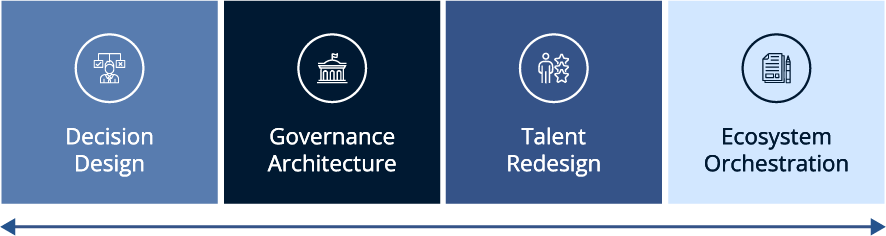
Figure 2: The Evolution of AI Strategy
The Mandate for Leaders
The future of work is being reshaped by AI. As systems take on defined decision rights, the architecture of the organization must evolve in parallel.
Competitive advantage will belong to the enterprises that prepare their organizations to integrate AI agents coherently – through data readiness, deliberate decision design, resilient governance, evolved talent strategy and disciplined ecosystem orchestration.
ISG helps enterprises navigate the rapidly changing market for agentic AI and optimize how they get work done. Contact us to find out how we can help your organization.
Please fill out this form to continue.
About the author