

Hello. This is Stanton Jones with what’s important in the IT and business services industry this week.
If someone forwarded you this briefing, consider subscribing here.
What You Need to Know
Service providers are making significant commitments today to deliver AI savings tomorrow. Since building the capabilities to realize those savings takes time, enterprises are asking their providers to prove how and when they will actually see those savings.
Data Watch
What's Happening?
There are lots of reasons enterprises buy managed services today: making things more efficient, getting access to extra capacity, tapping into expertise they don’t have in house, etc. But the number one reason, far and away in each of our studies and client interactions, is cost savings. Reducing the cost of operations is almost always the primary motivator.
As we’ve discussed at length over the past year or so, uncertainty in the market has made cost optimization even more of a priority. And getting access to those savings now, rather than in two years, is also a bigger priority.
At the same time, expectations around AI and the cost savings it promises (often realized via improved productivity) are surging as well. So, when a once-in-a-generation technology emerges simultaneously with growing cost pressure, it’s no surprise that initial use cases for that technology are primarily focused on productivity.
And productivity is what the IT services sector delivers. Year-over-year improvements in process and technology typically translate into savings. The expectations around AI have supercharged that cost savings value proposition, so – of course – providers are making commercial commitments around using AI to dramatically increase productivity.
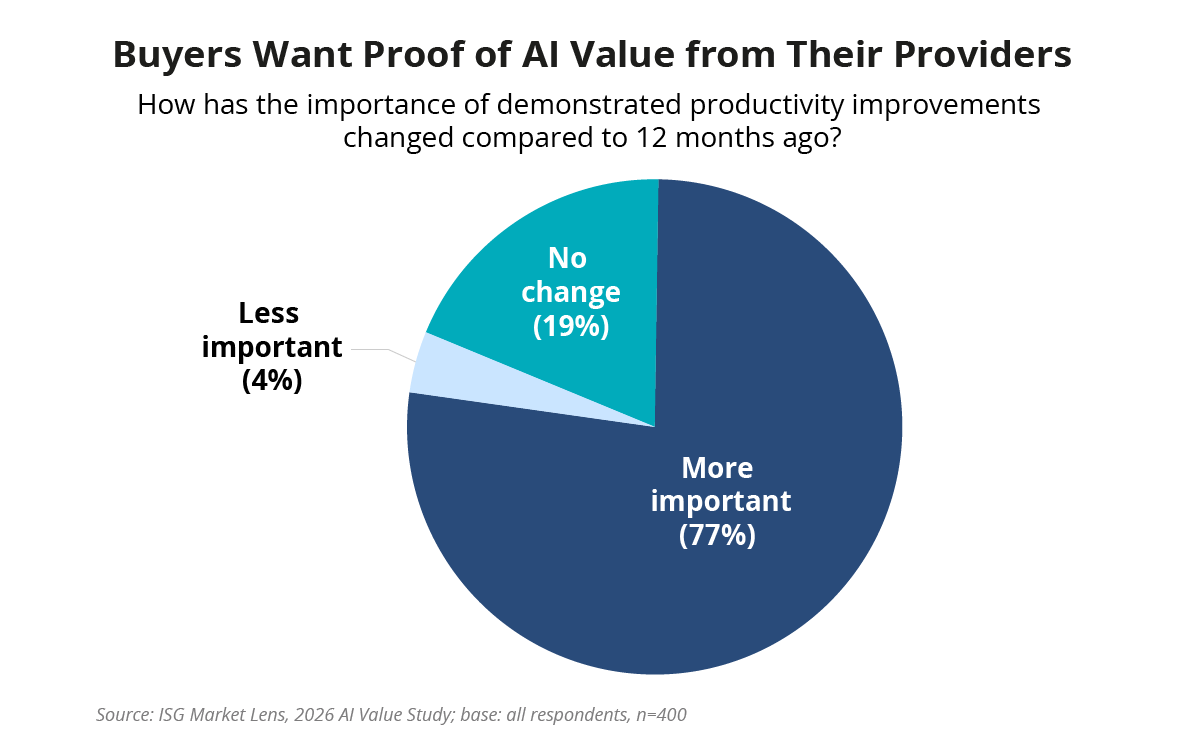
But, as you can see in this week’s Data Watch, enterprises are increasingly asking providers to prove it. In 2025, we saw a lot of dealmaking activity focused on the promise of these cost savings via big improvements in price productivity. What we’ve seen more recently in the data and in our advised work is a continuation of that price productivity but with greater requirements for demonstrating proof that AI will not just reduce costs – but reduce the actual work as well.
What's Next?
What’s important to understand here is that savings promised today are based on changes that are projected to get done over the term of the deal. Think of it as a backlog. Data needs to be remediated, architectures need to be modernized, processes and roles need to be redesigned, governance will change. This means that the work itself needs to change before enterprises can get value from AI at scale.
Service providers are effectively making a long-duration bet that they can build, industrialize and sustain AI-enabled productivity fast enough to meet both near-term savings expectations, which are often pulled forward to today, and that they can keep up with the evolving productivity curve as models improve.
The main takeaway: the commercial commitment in a managed services deal today is only the beginning. The value will depend on whether providers and enterprises can execute on the backlog of work required to realize it and sustain it over the full length of the deal.
About the author