


Hello. This is Alex Bakker and John Boccuzzi with what’s important in the IT and business services industry this week.
If someone forwarded you this briefing, consider subscribing here.
Context
The rise of agentic AI and LLMs has put significantly greater attention on enterprise data. Unlike previous software automation advances like RPA, AI is primarily attempting to automate decision-making. This is encouraging businesses to use AI to remove human interaction and oversight from parts of their work to increase productivity and reduce costs.
The problem is that the decisions that are being automated have to be right to be valuable – and a right decision requires having the right information at the right time. This has led to parallel discussions: first, how can organizations engineer their data to provide contextual meaning to their AI agents? And, second, how can they design agents and workflows to keep humans in the loop?
These are often being tackled at the same time, with data engineers, software integrations and platforms handling context, while business leaders and service providers work to redesign tasks and roles involved in validating AI decisions and ensuring there is no loss in quality.
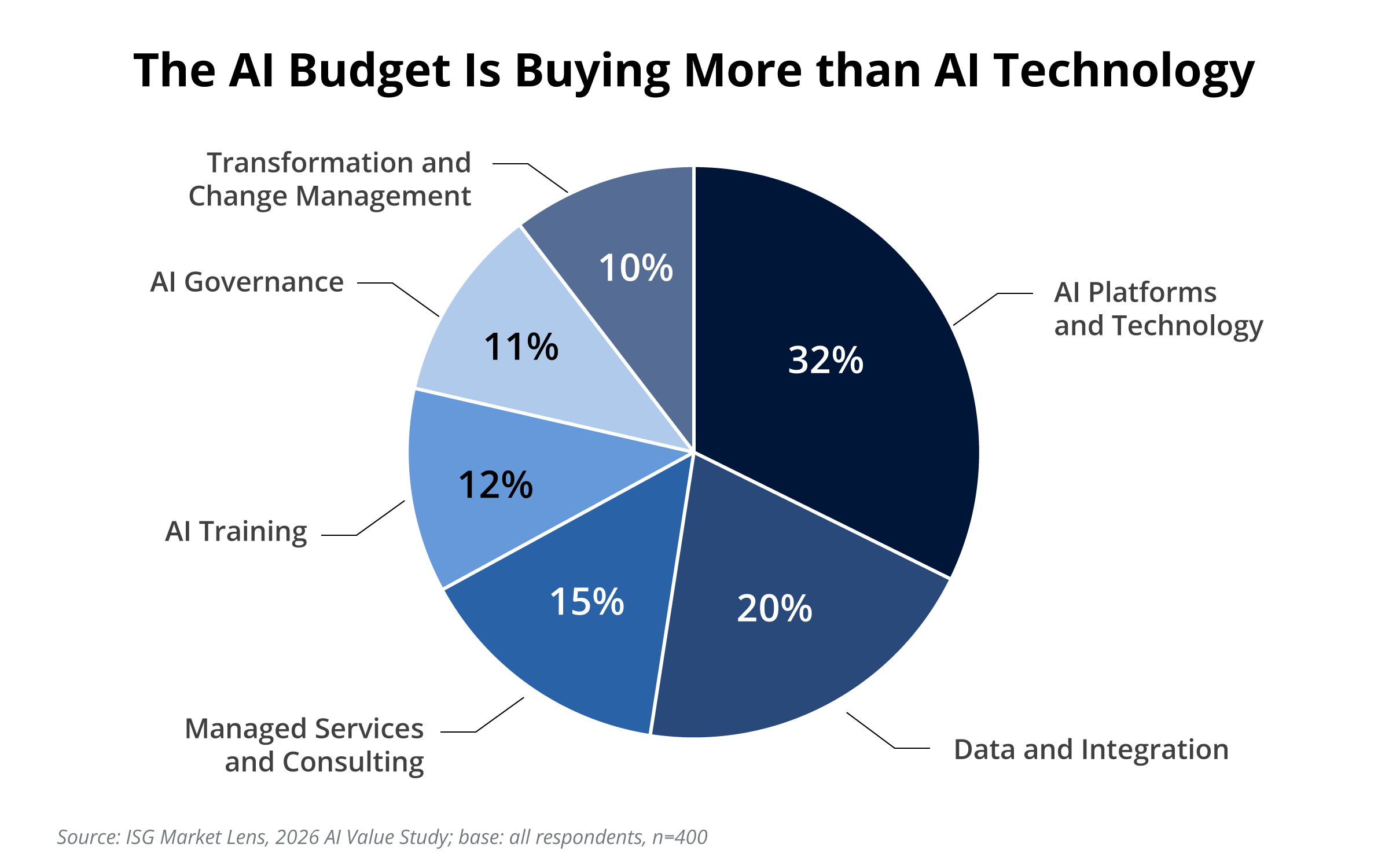
But these activities aren’t really separate. Validating AI output requires validating its inputs, and validating its inputs means that employees ultimately need to work from the same context as the AI. Trying to merge context and workflow is proving difficult. Budget numbers we’ve gathered in our recent ISG Market Lens AI Value Study underscore that difficulty.
This is where the conversation about context needs to widen. Context is not just an AI input; it is an organizational asset worthy of development. It includes how decisions get made, which information matters, how processes really work, the roles people play and the objectives and strategies that shape a choice.
Much of this is tacit knowledge held by employees, embedded in the current process rather than captured in data or systems. This kind of knowledge cannot simply be given to an AI agent. But it is just as valuable when building an agent as it is when training a new employee.
Everyone Is a Manager Now
As businesses merge context and workflow and push to integrate more sophisticated automation, the biggest implication is that validating the work tends to require more seniority and experience than the underlying tasks. That’s because validation requires understanding a broader context to handle exceptions and make informed judgment calls.
This has not been ignored, but it is presented as a risk of eliminating entry-level jobs. The conventional thesis is that increasing automation of routine work puts pressure on entry-level jobs. The challenge is that the financial benefits of automation, including cost savings, increased output and speed, do not accrue when work is bottlenecked at increasingly busy senior employees.
The implications are actually the opposite. Junior roles can be made more effective by the same organizational context that makes agents possible. In other words, AI outputs can be validated only when workers are managing agent context instead of double-checking the outputs from black box models. That means ensuring consistency in the information being fed to an agent and continually managing the intent of the AI.
The Agentic Pyramid
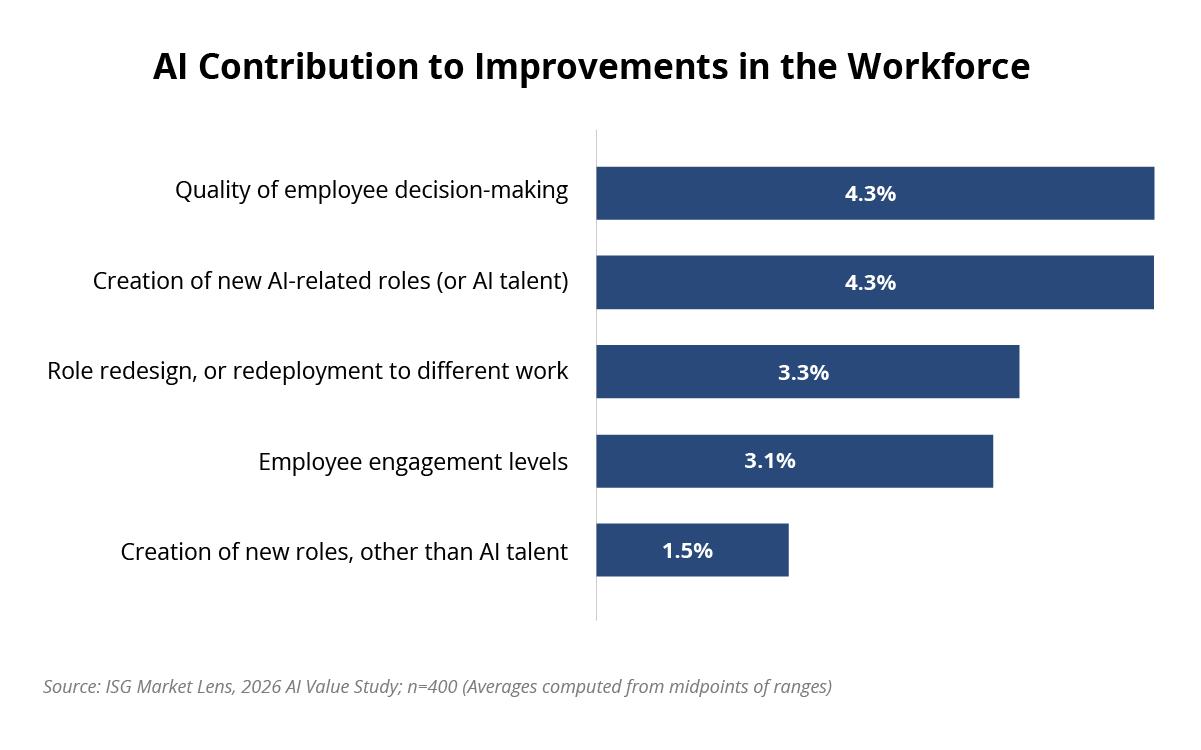
Our study demonstrates that AI’s strongest workforce impacts are improved decision-making and facilitating new AI-related roles and redesigned roles.
These impacts mark the beginning of a path that allows enterprises to improve quality and productivity through AI. What this means is that, instead of conceptualizing AI as a simple replacement for labor, we must treat it as a reallocation of new roles and skills to manage AI. These new roles will be managers of agents, and even entry-level roles will have a pyramid of agents under them.
The value of that pyramid will not come solely from having more agents. It will come from creating a shared operating context between employees and AI. AI is the forcing function; the asset being developed is organizational intentionality.
About the authors

Alex Bakker