
Hello. This is Stanton Jones with what’s important in the IT and business services industry this week.
If someone forwarded you this briefing, consider subscribing here.
What You Need to Know
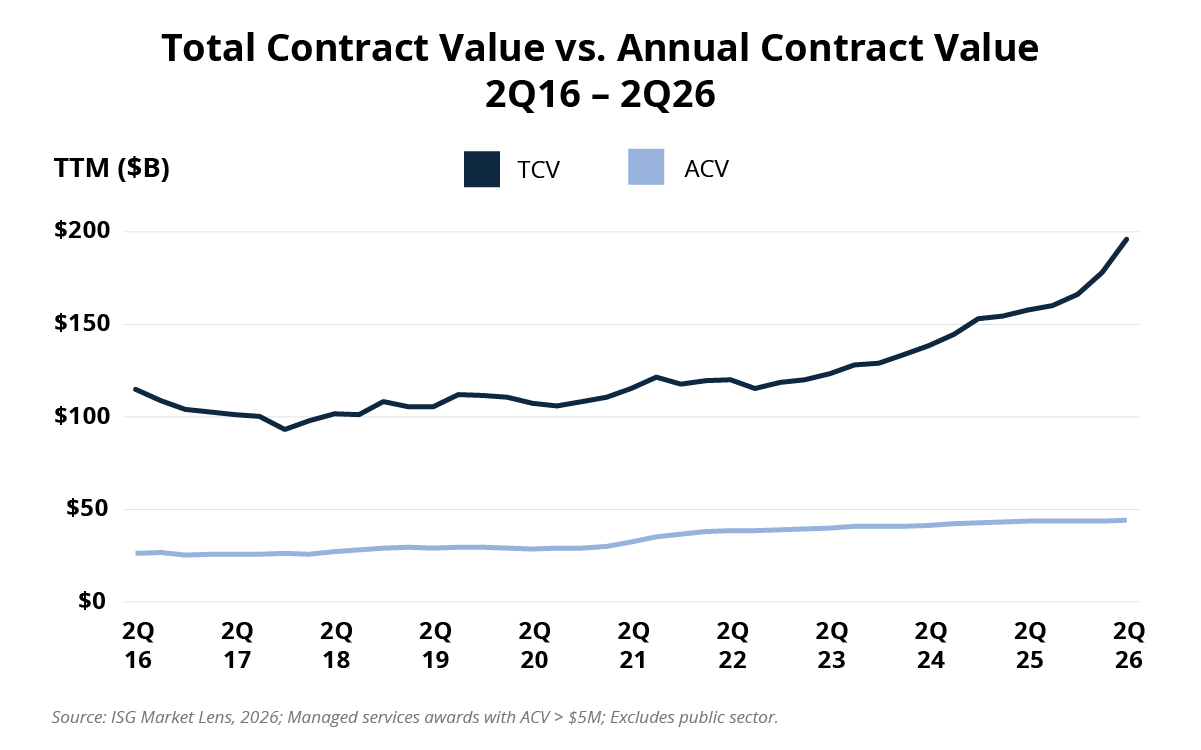
Longer managed services contracts are contributing to strong TCV growth in the sector, even as ACV growth remains relatively modest.
Data Watch
What's Happening?
We’ve been discussing at length over the past couple of years a big change that we’re seeing in the market: managed services contracts are getting longer. Today, average contract duration is 50% longer than it was in 2022.
In our view, there are a couple of reasons for this shift. First, macroeconomic uncertainty. Companies need to optimize costs, but given they’ve been in a cost-cutting mode for a while now, they’ve already pulled most of the traditional levers they can pull to reduce them. To get to the next round of 30 to 40% savings, enterprises need to re-look at their operating models. That includes architecture, data, processes and people. All these things take time to change.
A second reason is AI. Providers are committing to greater productivity gains, delivered faster than they were before 2024. This is in response to the expectation that AI will dramatically increase productivity. These expectations are creating an exceptionally competitive market, especially for incumbents that have to defend against these new expectations.
Enterprises need to optimize costs today, so locking in these anticipated savings from AI, while engineering the deal so savings are brought forward to today, is appealing for many companies in industries that are under pressure. For example, European auto manufacturers and U.S. healthcare providers, who are scrambling to reset cost baselines in the face of major marketplace shifts.
What's Next
So, what does this mean for the IT services sector as a whole?
As we discussed on the 2Q26 Index call, award activity continues to be strong, an indicator that outsourcing demand remains steady. At the same time, competition and anticipated AI-related productivity gains are putting pressure on pricing. Against that backdrop, longer contract durations are therefore a big contributor to the divergence between relatively modest ACV growth and continued TCV growth you can see above.
As we’re working with providers and investors, we often get the same question: will contract durations continue to grow at this pace?
There are a lot of moving parts in today’s market, but contract length is unlikely to continue to grow at the pace we’ve seen over the past three years. We believe durations will start to level off as enterprises and providers get a better grasp on how to – and how long it will take to – realize value from AI investments. And we expect to see greater confidence on both sides in how to deliver the benefits faster.
At the same time, we don’t anticipate significant changes in ACV growth, either positive or negative. Enterprise demand remains solid, but that’s balanced out by an exceptionally competitive market where the expectations of AI continue to put pressure on pricing.
About the author