


Hello. This is Alex Bakker and Loren Absher with what’s important in the IT and business services industry this week.
If someone forwarded you this briefing, consider subscribing here.
The Validation Bottleneck
By now, everyone who has used generative AI has been frustrated by the asymmetry between how much work it takes to prompt AI and how much time it takes to review the volume of content AI can produce. This is the crux of what we call the validation bottleneck and has been one of the core impediments to realizing value among early AI adopters.
Through August 2025, our AI Use Case Study showed organizations using AI primarily to reduce labor and cost. As AI has been injected into processes and tasks, however, it has generated new content, completed tasks and built up a backlog of work that requires a human in the loop (HITL) to validate, approve and respond. This validation work has generally added to the manual work those same employees were already doing. AI created workload before reducing it despite the expectation that it would reduce headcount. Over the past year, we have heard this repeatedly from service providers whose ability to move AI use cases into production is constrained more by their clients’ capacity to review outputs than by AI’s capacity to generate them. Companies rarely want to hire additional validation staff.
Humans on the Loop
A year later, our ISG Market Lens 2026 AI Value Study shows a shift happening. The validation bottleneck persists, but priorities have changed. Staff reductions and immediate cost savings have moved down the priority list and have been replaced by staff productivity and improved agility/response times.
This may seem like a small shift, but the impact is significant. Last year, use cases centered on content generation and custom chatbots. These use cases treat AI like an application: value depends on employees recognizing when they need it, supplying the context and reviewing the response. This year, AI value has accrued mostly to companies that use it for task and workflow automation, data analysis and process optimization. These use cases treat AI more like process infrastructure.
Content generation was rarely the bottleneck. Writing an email was easy; gathering the context and deciding what it should say was the real work. Rather than waiting for an employee to ask, process-integrated AI can monitor information, identify material changes, assemble the relevant context and bring the employee a bounded issue or decision to assess. The employee no longer has to determine that a decision is needed before beginning to make it.
Consider a dashboard that employees are expected to check even though its numbers rarely change. The difficult work is not reading the dashboard; it is recognizing when a change is material, interpreting it in a broader context and deciding what to do. AI used correctly can perform the continuous monitoring and context gathering, then alert the employee when something requires judgment.
Data Watch
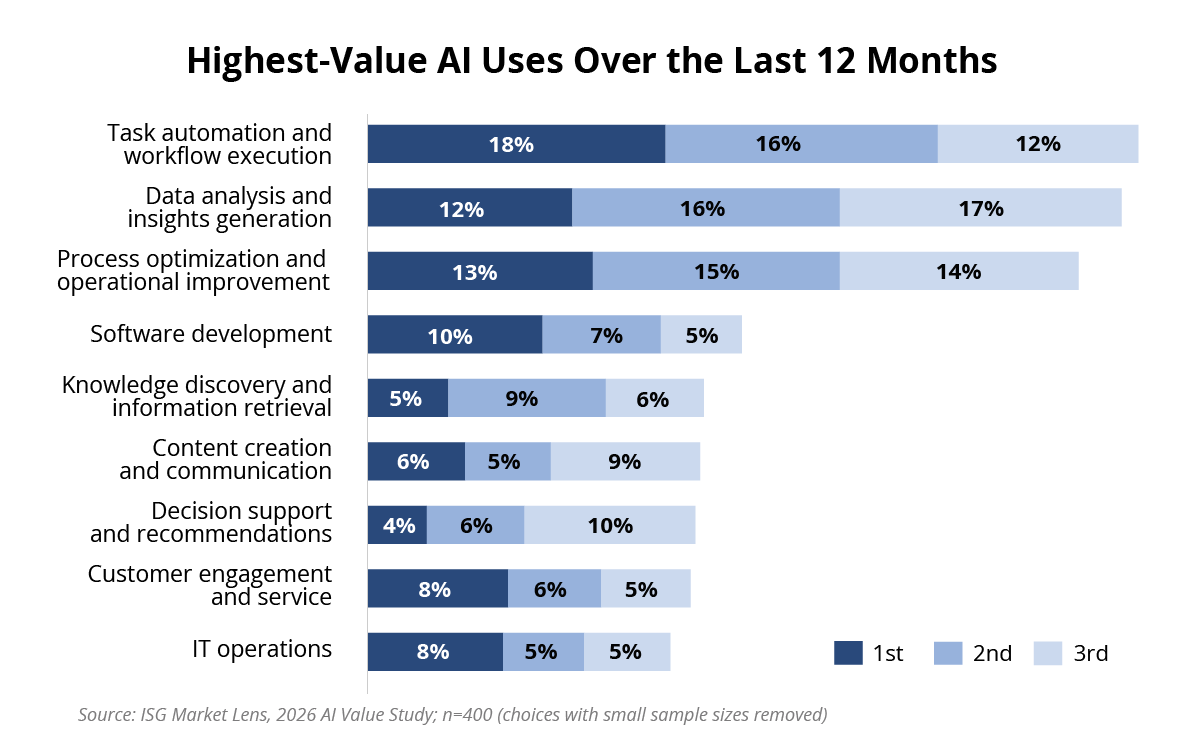
Even among organizations with the most mature AI adoption, the proportion of completely autonomous work is expected to grow only from 10% of tasks today to 17% by year-end 2027. This doesn’t mean those organizations are not successful – they are already getting more significant value than 80% of organizations we surveyed. What it shows is that those getting the most value are those that do not expect AI to do the whole job but are comfortable having it gradually perform a greater portion of the individual tasks.
The question, then, is not whether an entire job can be automated, but exactly where to put AI within the work. When AI performs the whole job, the employee becomes an auditor who must reconstruct and validate the whole result. When AI supports the workflow, the employee continues to perform the judgment-bearing work while spending less effort recognizing that work, assembling its context and preparing to act. Validation remains embedded in doing the work instead of becoming another layer of work.
This does not mean AI is ineffective in software development or content creation. Those use cases can create significant value, but they remain hands-on when employees must define the task, provide the context and validate the output. A higher-value way to use AI treats it less like an application and more like process infrastructure. Employees should not have to chat with AI constantly; the process should invoke it when information becomes material, the process needs input from the real world or a decision requires attention. The greatest value may come when employees no longer have to “use” AI at all.
About the authors

Alex Bakker