


Hello. This is Stanton Jones and Sunder Sarangan with what’s important in the IT and business services industry this week.
If someone forwarded you this briefing, consider subscribing here.
What You Need to Know
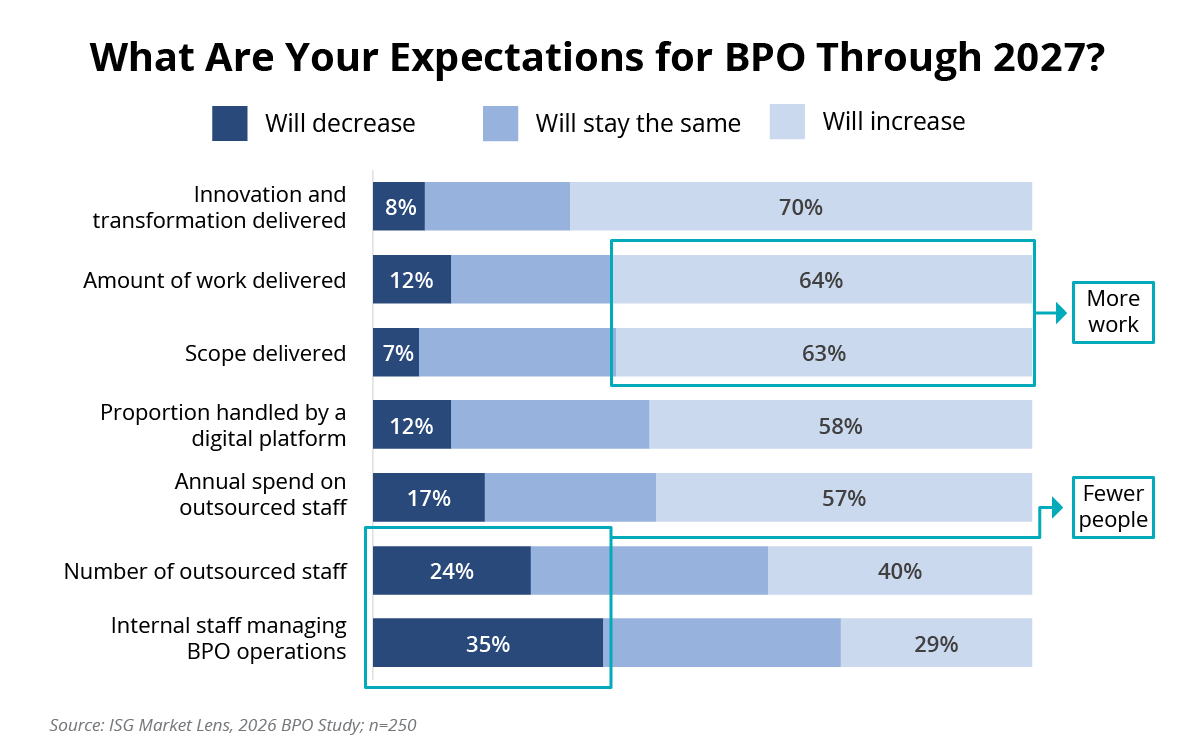
Most enterprises expect the number of BPO staff – both provider and internal – to decrease in 2026, even as they increase the scope and volume of work they give to BPO providers.
Data Watch
Background
Given how task-oriented BPO services tend to be, they are often seen as a “canary in the coal mine” for big technology shifts in the IT and business services sector. Tasks are infinitely easier to automate than roles, so when new tech emerges like RPA yesterday – or AI today – it often impacts the BPO sector first.
Our new BPO study gives us yet another data point to see how AI expectations may be impacting the sector. As you can see in this week’s Data Watch, most enterprises expect to increase the amount of work delivered via BPO through 2027, while at the same time they expect to see a reduction in the headcount needed to support it.
The Details
- Over 60% of enterprises we talked to expect to increase the scope and overall amount of work delivered via BPO over the next two years.
- Around one third of respondents indicated they expect to decrease the number of outsourced and internal staff supporting their BPO operations.
- And while work expectations are up, and staff expectations are down, 70% of respondents are expecting to see an increase in innovation.
What It Means
A few weeks ago, we asked Is the Great Revenue Decoupling Finally Here? That brief was from a provider point of view, and focused on whether provider headcount will hold steady while revenue growth increases. In this case, this week’s Data Watch is looking at this topic from the buyer’s point of view. And overall, what we’re seeing from BPO buyers is a desire to “do more and use less."
In our view, the heightened expectation for innovation and transformation is almost entirely due to a combination of AI and automation which will further challenge the current scope of all BPO providers.
However, there are some green shoots here: nearly 50% of respondents in this survey indicated that their largest BPO contract was less than $5 million of ACV. That means a lot of BPO work is happening under the radar. Much of it is starting small and growing over time. This is good news for providers as it creates more opportunity, but it also means providers will need to drive even more efficiency into their operations in order to profitably sell and deliver on these smaller awards.
We’ll cover a lot more detail on what’s happening in BPO on our 1Q26 ISG Index Call on April 16. You can register here.
About the authors

Stanton Jones