


Hello. This is Stanton Jones and Steve Hall with what’s important in the IT and business services industry this week.
If someone forwarded you this briefing, consider subscribing here.
What You Need to Know
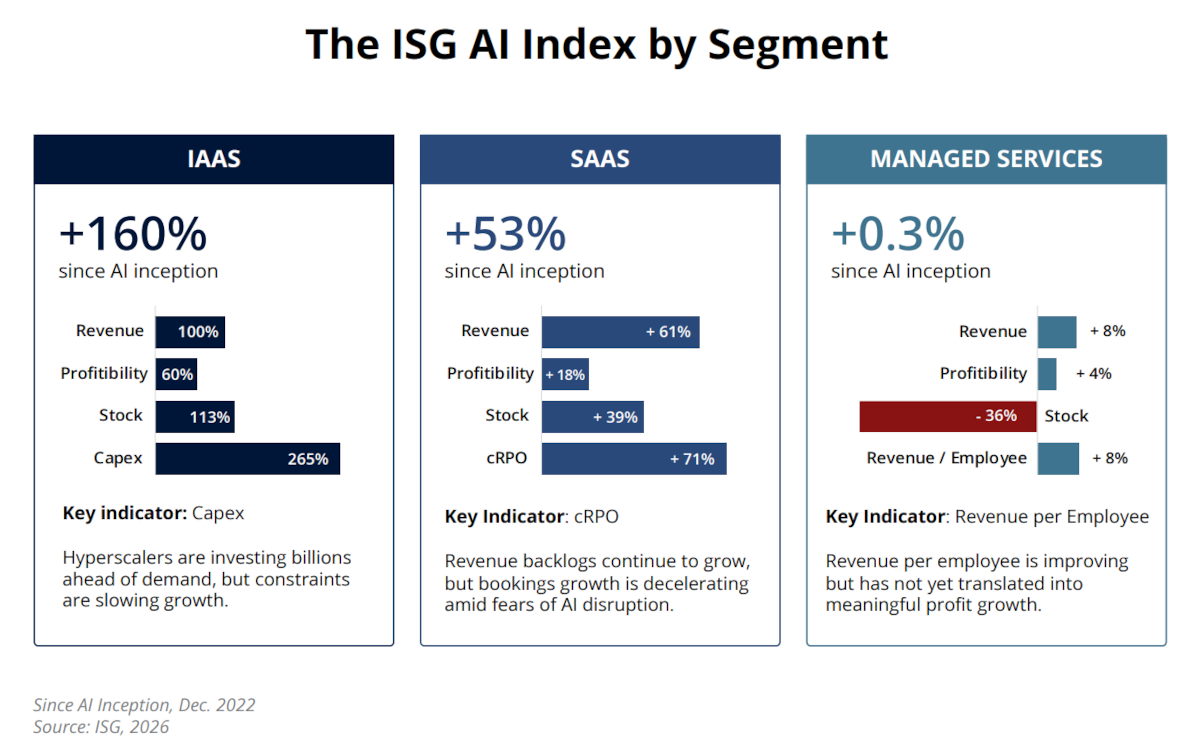
The new ISG AI Index gives us some interesting findings into how AI is impacting the three major market segments we cover. It shows that the hyperscalers are clearly capturing the early value in AI, but will this value eventually flow into IT services?
Data Watch
Background
We introduced the ISG AI Index on the 1Q26 Index call last week to better understand how AI is impacting the technology services market. The index tracks three segments, each with a forward-looking AI indicator: capital expenditure for infrastructure, current remaining performance obligation (cRPO) for software and revenue per employee for services. The measurements start from December 2022, which we’re using as the starting point of LLM-based AI adoption.
The Details
- IaaS: Up 160%; the hyperscalers are investing billions of dollars in capex this year, but input constraints and growing regional concerns are acting as a governor on growth.
- SaaS: up 53%; revenue backlogs continue to grow, but bookings growth is decelerating as cost pressures grow and pricing models evolve.
- Managed Services: up 0.3%; service providers are generating more revenue per employee, but there has not yet been a meaningful increase in revenues or profitability since the AI inflection point.
Headwind or Tailwind?
Given the relatively weak composite index for managed services, the question then becomes: is AI a headwind or a tailwind for IT services?
It depends on where a provider sits. We believe AI is deflationary to routine, pattern-based work where LLMs excel: coding, testing, documentation, etc. Providers with heavy exposure to those areas, especially those with offerings that use a commercial model based on hours and rates, will face immense pricing and schedule pressure.
At the same time, AI is also likely to increase the available volume of work. As my colleague Alex Bakker wrote a few weeks ago, “Improving the efficiency of software development does not necessarily reduce total demand for development. It increases it. When the effective cost and risk of delivery go down, more projects become economically viable.” This could mean more large systems-integration work, as well as smaller, short-cycle project work.
And it’s not just that many of yesterday’s shelved projects have become economically viable today due to AI. It also means new opportunity. Probabilistic engineering – software engineering using rapidly improving models and the harnesses that support them – will change the way and the rate at which software is created. This is going to mean yet another wave of massive change for enterprises that are already dealing with too much complexity and a dearth of skills.
In our view, this shift is likely to drive net-new services growth for at least the next decade. Services firms that are already thinking about how to incorporate probabilistic engineering into today’s deterministic systems and operating models will be the first to capture the real value in AI.
You can read more about the new ISG AI Index here.
About the authors

Stanton Jones