


Hello. This is Stanton Jones and Stacey Cadigan with what’s important in the IT and business services industry this week.
If someone forwarded you this briefing, consider subscribing here.
What You Need to Know
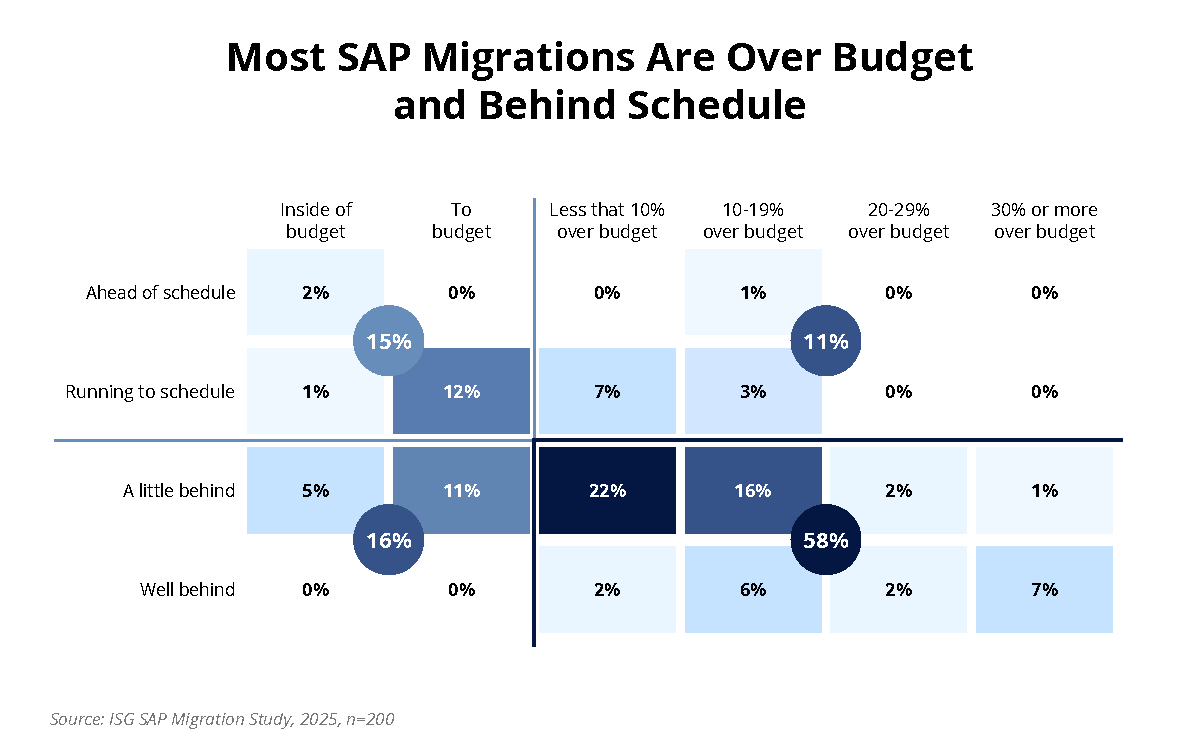
Most SAP migration programs are over budget and behind schedule. Is this a provider problem, an enterprise problem or an SAP problem?
Data Watch
Background
Given the significant pressure we continue to see on discretionary and project-based spending, we wanted to dig into the details around current SAP migration timelines and budgets. We used data from our recent SAP migrations study as the foundation (download the report here).
The results are pretty sobering. As you can see in this week’s Data Watch, more than half of the SAP migrations we studied are both over budget and behind schedule.
The Details
- 58% of SAP migrations are over budget and behind schedule.
- 27% are either over budget or behind schedule.
- Only 15% of migrations are on budget and on time.
Why It’s Happening
These migrations are often massive, complex undertakings. They involve multiple enterprise stakeholders, multiple service providers and, of course, SAP. So, in answer to the question, is this a provider problem, an enterprise problem or an SAP problem, the answer is “yes.”
As we discussed in the report, the majority of migration programs are focused on minimizing disruption rather than driving transformation. Many large organizations have set up ECC so that it is working the way they intended, and they are not eager to risk the cost and effort on an uncertain outcome. This can limit an enterprise’s drive to standardize processes and clean up data. That trade off tends to surface later in the form of rework, scope expansion and delays.
Service providers are often brought in to execute but are also increasingly expected to challenge client assumptions and drive process change. That shift is not always aligned with how engagements are structured, which can lead to misaligned incentives, and, of course, delays and overruns.
And, finally, the shift to SAP’s cloud and its bundled subscription models can introduce significant cost and operating model changes, including the need to run both on-prem and cloud models simultaneously for some period of time. These are budget busters, and, often, the legacy systems don’t get fully turned off, so that cost never goes away. This is one of the main reasons we see a 3% increase in post-migration costs for large companies.
Ultimately, in our view, this boils down to good governance. However, both on the ground and in this data, we see enterprises underweighting how critical good governance is to migration success. Multiple providers, unclear decision rights, loosely defined acceptance criteria and gaps in accountability can create a scenario in which it’s almost guaranteed that neither budgets nor schedules will meet expectations.
We’ll talk more about what we see happening with SAP on the 1Q26 ISG Index Call on April 16. You can register here.
About the authors

Stanton Jones