

Hello. This is Alex Bakker and Paul Reynolds with what’s important in the IT and business services industry this week.
If someone forwarded you this briefing, consider subscribing here.
Proof of Delivery
As AI has proliferated, many service providers are now redoubling their efforts to move clients to outcome-based pricing for contracted services. But that may be putting the cart before the horse. Outcome-based pricing is difficult to describe to clients who lack confidence in a provider’s ability to measure the effectiveness of its AI solutions.
For several years, our ISG Market Lens studies have asked, “What can providers do to improve their services?” Almost universally, the leading response is that providers should help clients better understand their businesses. The thematic throughline in these responses has been a disconnect between what the providers prioritize and what the client values—even when a provider was successfully delivering against the contract.
Our recent AI value study shows something different. 77% of clients say that a provider’s ability to demonstrate productivity improvements and deliver measurable business outcomes are more important than they were 12 months ago (see Data Watch). What this indicates is that because of the impact of AI, clients are sharpening the expectations they have regarding their providers.
Data Watch
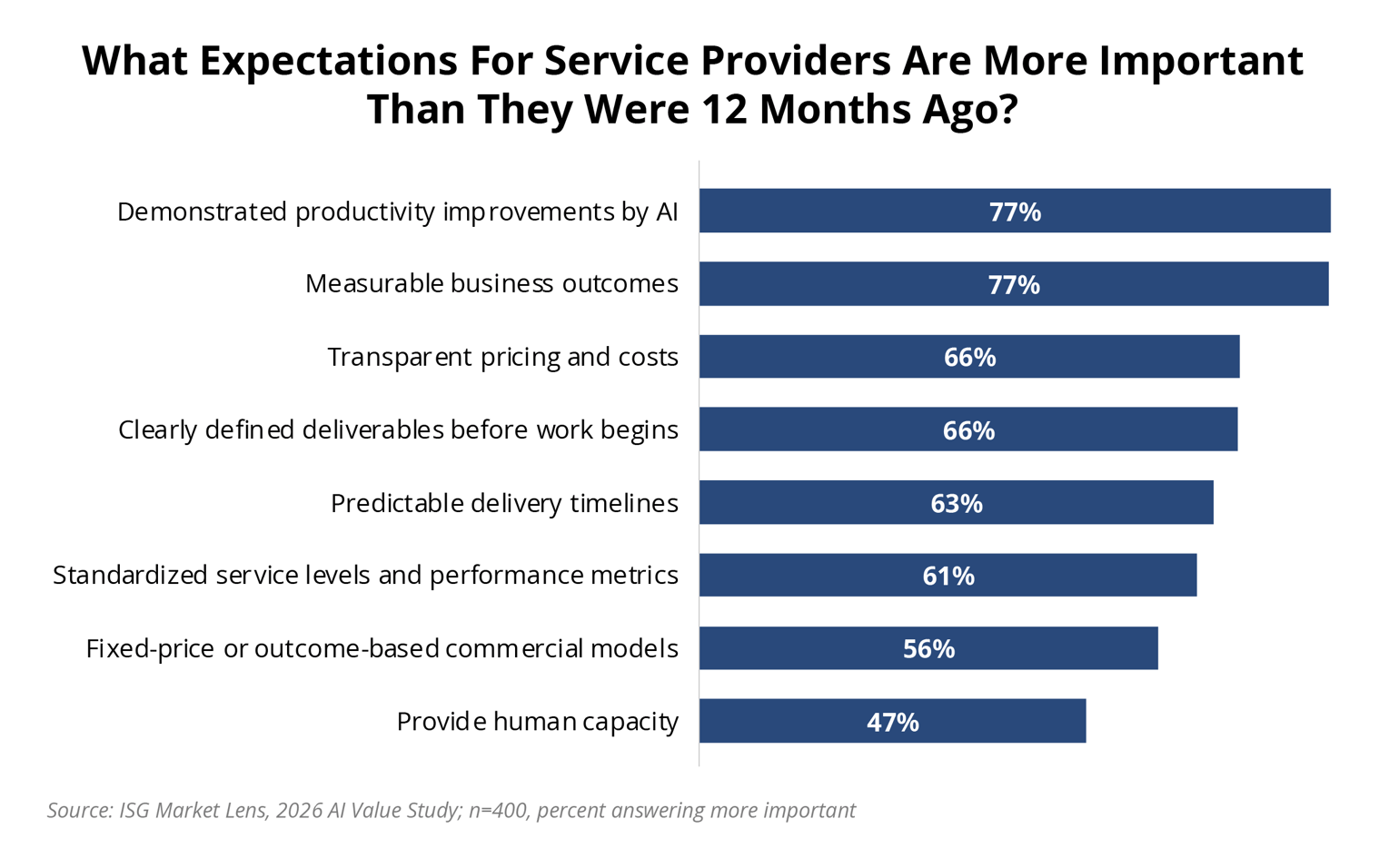
You Can't Manage What You Can't Measure
Responses to our study went deeper than just prioritizing measurement and demonstrable productivity. These open-ended responses highlight the degree to which this mismatch between measurement and outcomes is frustrating clients and undermining their trust in providers.
“Most managed service providers struggle to understand the business value of a specific initiative. These priorities tend to be very company specific...”
“Make a template to document up front how we will measure ROI so we don’t have to figure it out ourselves. Total cost today versus total cost once we have the solution in place.”
“Probably the largest gap is that many MSPs still focus on deploying AI rather than ensuring we (as a company) realize measurable business from it.”
“Understand our business better and then recommend the right solutions rather than trying to bend our business to the solution they have in mind beforehand....this hasn't changed in the AI world - has always been the challenge with service providers.”
“Our experience with MSPs is that they have a lot of fancy words but don't give confidence that at the end of the project there will be tangible savings. We can't sign a contract based on vague hope.”
Getting to Outcomes
Our study shows that many organizations are maturing on their journey to AI value. But it also highlights a concerning disconnect between providers and their clients. Providers have already correctly identified that a focus on client outcomes is critical, but these measurement mismatches show that they haven’t built the necessary confidence in their ability to measure and attribute value to their activities.
In many ways this is not a new concern. Organizations have long struggled to fully articulate the value they get from their technology. AI intensifies this concern, making that ambiguity increasingly difficult to tolerate. Providers are asking clients to automate more work, give technology greater responsibility and, eventually, contract around the outcomes those systems produce. That requires both parties to have a much clearer understanding of what success looks like and how it will be measured.
This is also why the path to outcome-based managed services probably does not begin with the pricing model. It begins with providers giving clients confidence that they can define and measure the outcomes of the work they already perform.
Clients need providers that they can manage against the objectives of their business. If providers cannot give them credible measures for doing that, it will be difficult for clients to give those providers greater responsibility for the outcome.
About the authors

Alex Bakker

Paul Reynolds
Partner and Chief Research Officer
Paul Reynolds leads Momentum, a division of ISG that provides research services to help service providers better target, win and retain business. Paul has 25 years of market research experience with specific expertise in methodology development, data analytics and research process design. Having found many service providers’ Advisor Relations functions to lack appropriate analytics, Paul is working to develop innovative new approaches that allow for data-driven programs based on the unique needs of each client. His approach benefits Advisor Relations, go-to-market functions, sales, strategy, marketing, and market/competitive intelligence teams.
