

.jpg?length=100&name=david_menninger-square%20(1).jpg)
Hello. This is Stanton Jones and Dave Menninger with what’s important in the IT and business services industry this week.
If someone forwarded you this briefing, consider subscribing here.
Cloud
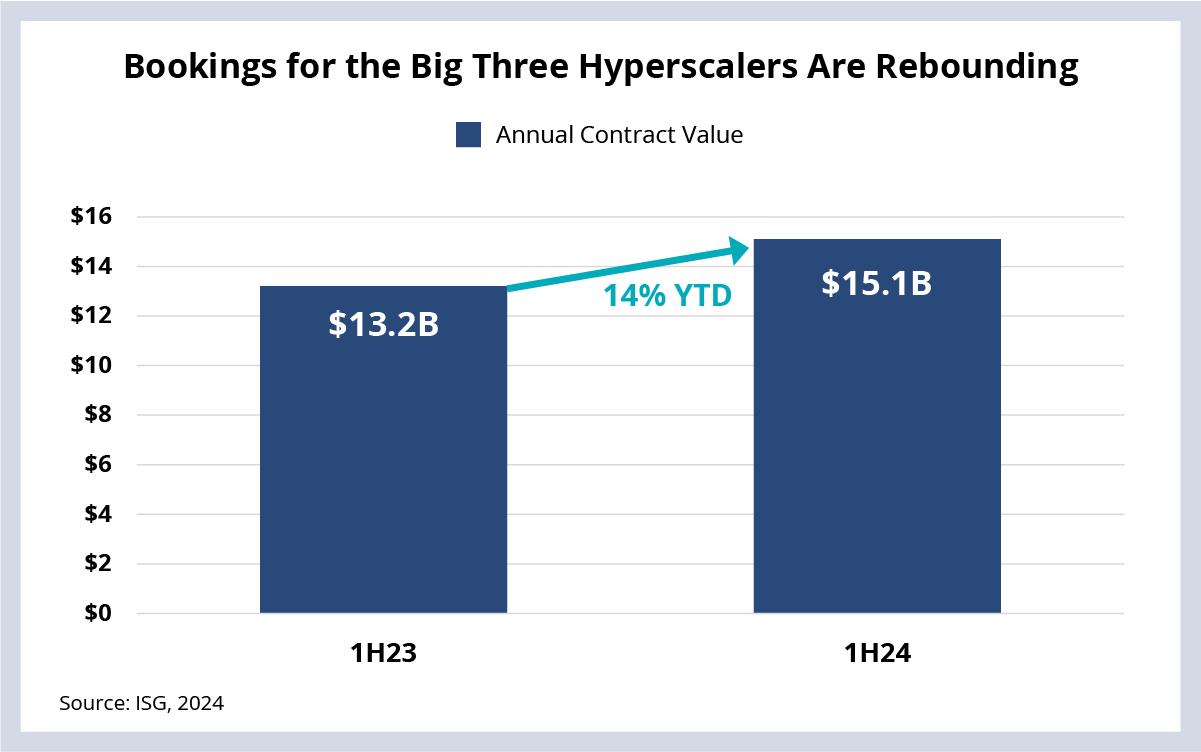
Bookings for the big three hyperscalers are rebounding on strong demand for AI. Will AI-driven complexity create more opportunity for managed service providers?
Data Watch
Background
IaaS bookings growth was very strong through 2022, then went negative for five consecutive quarters as enterprises responded to the uncertain macroeconomic climate by optimizing their existing cloud investments.
That has changed in 2024: year-to-date bookings for the big three hyperscalers – AWS, Google and Microsoft – are up double digits.
We believe that AI is driving some of this new growth and that it has legs as enterprises plan to increase their consumption of IaaS in 2025.
The Details
- Bookings for AWS, Google and Microsoft are up 14% year to date.
- 40% of enterprises plan on increasing their cloud consumption over the next 12 months.
What’s Next?
AWS, Google and Microsoft have an expanding portfolio of enabling technologies for both data and AI (which is driving some of the aforementioned growth). They want as much of this AI work to stay in their ecosystem as possible, but there is also an emerging trend of interoperability of data and AI services across cloud computing environments.
For example, the new interoperability of Oracle Cloud Infrastructure across AWS, Azure and GCP will make it easier for enterprises to blend AI and data services across cloud providers.
While deploying data and AI services within large clouds may be getting easier, what will likely not be getting easier is managing the entire cloud estate. Enterprise cloud environments are already complex; this shift to an inter-cloud data and AI architecture could introduce even more complexity.
Almost half of enterprises plan on consolidating the number of MSPs they use to manage cloud over the next 12 months. However, given the enormous amount of demand for data and AI services – and the increased complexity this will likely introduce into enterprise environments – this may not be a realistic goal for sourcing and technology leaders in 2025.
About the authors

Stanton Jones
.jpg?length=256&name=david_menninger-square%20(1).jpg)
