

ISG was on the ground at AWS re:Invent 2025 to capture firsthand the key announcements, strategic shifts and enterprise implications shaping the future of cloud and AI.
What We Saw and Heard at re:Invent
AWS re:Invent 2025 was not just another cloud conference. It was a showcase of how the industry is moving from GenAI experimentation to the operationalization of agentic systems. Across keynotes, deep dives and roundtables, there were several defining themes and signals:
1. AWS’s Agentic Platform Vision
AWS positioned itself as more than a cloud provider, unveiling a full-stack AI platform that spans:
Custom AI chips designed specifically for cloud workloads (such as AWS Trainium and Inferentia, and processors delivered through NVIDIA partnerships) to improve performance, reduce costs, and optimize energy efficiency for AI training and inference.
Global and sovereign cloud infrastructure
Federated data layers and multi-cloud interconnect
Agentic AI software stack (including AWS products like Bedrock, AgentCore, policy engines, evaluation frameworks)
Industry-grade governance, auditability and compliance
The message is clear: AI is now operational, governed and embedded into the digital core. It is not an add-on. AWS is betting that autonomous, governed agents will orchestrate applications, data and infrastructure.
2. Major Announcements & Signals
The chart below distils the key announcements from AWS re:Invent into the major technology domains that will influence enterprise cloud and AI strategies in the coming years.
|
Area |
Highlights |
|
Agentic Platform Stack |
Bedrock Agents, AgentCore, Policy Engine, Agent Eval, integrated memory handling |
|
AI Infrastructure |
Trainium 3/4 roadmap, NVIDIA UltraServers, “AI factories” for large-scale deployments |
|
Sovereignty |
European Sovereign Cloud, isolated governance models, sovereign deployment blueprints |
|
Data Strategy |
Federated cataloging, multi-cloud orchestration standards, S3 Vector, data fabric direction |
|
Interoperability |
AWS Interconnect for Multi-Cloud, Open API governance approach |
AWS Transform: Making System Migration a First-Class Capability
A notable but under-discussed element this year was AWS Transform, which explicitly supports:
Transitioning from one AI vendor to another (e.g., Anthropic ↔ OpenAI)
Moving from commercial models to open source, or vice versa
Modernizing legacy platforms (e.g., mainframes) while preserving optionality
This reframes cloud strategy. The ability to exit a provider relationship becomes as important as the ability to enter other ones. For enterprises, this directly affects long-term TCO models, contract duration and renegotiation leverage, and business continuity and resilience planning.
3. Market and Ecosystem Shifts
Cloud → AI operating systems: Agents are becoming the new runtime layer, abstracting application logic and automations.
Sovereign and regulated AI: Technical sovereignty is now enforceable, impacting procurement, compliance, and operating models—especially in regulated sectors.
Modernization accelerates: Agentic tooling and multi-cloud data access are reducing friction for legacy system replacement.
Partner model matures: Service revenue is shifting from migration to governance, orchestration and operationalization.
What This Means for Enterprises
Enterprises have the opportunity – if they seize it – to take advantage of the following capabilities:
Rapid automation of knowledge and decision workflows
Adaptive, personalized digital services
Embedded compliance and policy-driven operations
Hybrid and sovereign AI without architectural reinvention
Exit readiness and vendor flexibility as a strategic advantage
Along with the opportunities come risks and challenges. Enterprises should prepare to tackle the following:
Governance maturity gaps
Legacy data quality issues
Contracts not designed for autonomous systems
Talent shortages in AI architecture and safety engineering
While AWS’s architecture is coherent and forward-looking, many enterprises are not yet fully prepared. Three maturity gaps stand out:
Data preparedness: Most organizations still manage fragmented, legacy data environments.
Organizational change: New roles and skills are needed, including AI risk managers, agent lifecycle owners and governance engineers.
Measurable ROI: Enterprises must move from PoCs to operational KPIs that include automation accuracy, compliance and service-level consistency.
How AWS Stacks Up
AWS is staking its claim as the leader in infrastructure, sovereignty, agent orchestration and now, exit strategy – especially for regulated and global enterprises. How does it compare to competitors in the market? Microsoft leads in monetizing AI via Copilot and SaaS integration; Google Cloud excels in foundational model innovation and research.
The competitive landscape is shifting from “best model wins” to “best governed execution stack wins.” AWS is betting that enterprises will choose scale, integration, sovereignty, operational control and the ability to exit or pivot without disruption.
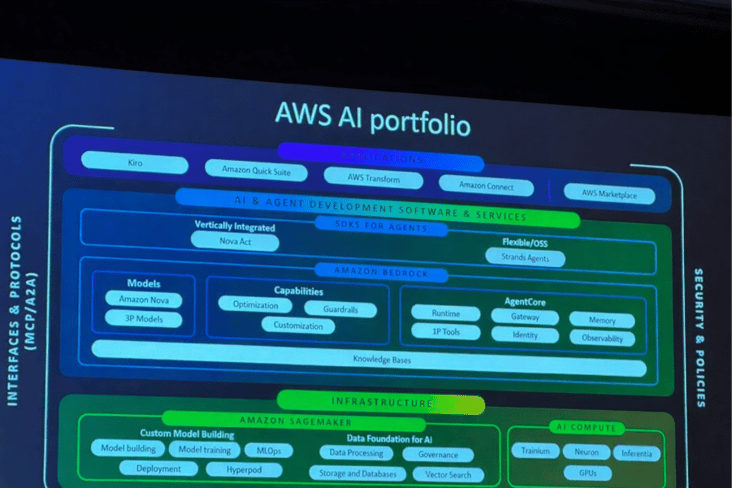
Source: AWS (Image captured during re:Invent sessions)
Advice for Enterprises and Technology Leaders
To realize the benefits of agentic platforms and avoid future risks, ISG recommends that enterprises take the following steps:
Build a model to compare exit costs and vendor flexibility in all AI/cloud investments; leverage AWS Transform to make exiting a first-class capability.
Prioritize architectures that decouple models from workflows to enable agility and reduce systemic risk.
Treat interoperability and standards as non-negotiable for procurement and integration.
Update contracts and SLAs to reflect agentic systems, autonomous decision-making and portability.
Build governance and risk management capabilities; technology alone won’t mitigate AI risk.
Champion organizational change: upskill teams, redesign roles and foster a culture of continuous improvement.
Be careful to avoid the pitfall of treating agentic transformation as a tech upgrade. Instead, treat it as an operating model shift.
What AI Is Doing to Enterprise Platform Deals
AWS re:Invent 2025 signals a fundamental shift in enterprise platform economics. The old paradigm of vendor-centric stacks and long-term lock-in is giving way to ecosystem-centric platforms, governance-driven optionality and architectures designed for exit.
Agentic AI is the catalyst. Autonomous systems cannot remain tightly coupled to a single vendor without amplifying systemic risk. AWS’s multi-model abstraction, agent policy engines, sovereign cloud constructs and the AWS Transform initiative position it as a good option for regulated, global enterprises ready to move from experimentation to execution—with exit readiness as a new pillar of resilience.
But success requires more than technology. Enterprises must build maturity in data, governance and organizational change. The winners will be those who treat agentic transformation as an operating model shift – not just a tech upgrade.
The question is no longer “should we adopt AI?” but “how do we build the maturity to operate in a world where systems act – not just respond?” AWS has shown its vision. Now, it’s up to enterprise leaders to decide how – and how fast – to meet it.
About the author