


Germany’s Industrial AI Reality Check
ISG’s 2025 study of IT budgets shows that 90% of traditional German asset-heavy industrial firms were spending 5% or less of their digital and IT budgets on AI investments. This means they are trailing far behind adjacent industries, in which investments of this kind reach anywhere up to 15%. This concerning statistic puts them at danger of not only forfeiting the global lead on AI adoption, but also of letting their competitiveness decline at an alarming rate.
The trend isn’t new – DACH is widely regarded as a region experiencing slow adoption of AI technologies. This perception of being a laggard in comparison to global markets was only strengthened at the international AI Action Summit held in Paris in early 2025.
Why This Moment Cannot Be Missed
Despite the pessimistic picture, there is a narrow window of opportunity that hasn’t closed yet. Recent public and private investments in the industrial application of AI in Germany – including the government “going all in” on AI investments and NVIDIA announcing the world’s first industrial AI cloud – are signs that the German industrial powerhouses may yet be capable of avoiding the slip into irrelevancy.
But just how have the manufacturers reacted to such news? Are they learning from peers in gaining value and, more importantly, a responsible embrace of AI – one that extends beyond ethics and the EU AI Act?
Why Responsible AI Encompasses More Than Just Ethics
Early definitions of responsible AI were dominated by the ethics of such technology, and rightly so. This has been brought about by reports of AI applications being racist, sexist and generally not reliable.
Considering an ethical dimension brought awareness to the concerns raised from having a “black box” approach. However, as we evolve, this concept must extend further, particularly as the investments to date are not yielding the expected rewards. After all, any investment in AI is effectively taking resources from elsewhere – and not necessarily in an efficient way.
Responsible AI must grow to include questions of architecture and business viability, instead of purely matters of compliance. It should ask: am I prioritizing the right problem? Does this problem really need to be solved by AI, or could we use traditional process optimization instead, consuming less cloud resources? It should also include considerations of holistic resource investment: are there clear benefits that further the overall business strategy by contributing to the core products and services?
Why Industrial AI Spending Fails to Deliver Value
The AI share of the overall IT budget for industrial enterprises is meager, but this isn’t necessarily true for the amounts allocated to individual solutions. ISG’s latest study on AI Enterprise Adoption shows that close to 80% of European asset-heavy companies are spending anywhere between €50,000 and two million Euros per use case. It is a significant investment that can’t be justified solely by economies of scale for already existing infrastructure, especially when the overall return of value in outcomes has been disappointing. Many enterprises have been caught off guard by the realization that high spending does not automatically equal high impact.
A big part of the answer lies in that which asset-heavy industries have been investing. The top use cases relate mostly to process improvement, optimization and sales forecasting. While these are likely to move the needle on organizational efficiency and check the boxes in the AI plans of the firms, they are unlikely to provide insights that will help improve products and services or ultimately ensure organizational longevity. This misallocation of funds to modest AI initiatives with unclear ROI is creating a situation that is ripe for AI to be considered a technological fad.
Figure 1 shows the top twenty use cases in which organizations have already invested, including those in pilot or testing mode.
Top 20 AI Use Cases
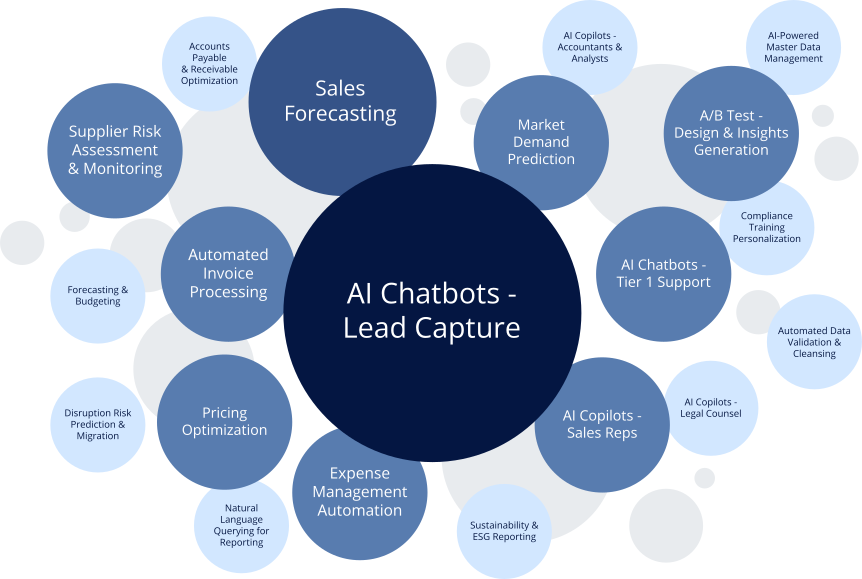
Figure 1: Top AI Uses Cases in European Heavy Industrial Enterprises
The Trap of the “Faster Horse” in Industrial AI
It has been almost 100 years since Henry Ford made the famous remark: “If I had asked people what they wanted, they would have said faster horses.” Today, asset-heavy industries are facing the same lack of ambition. They are too focused on optimizing processes to rethink tomorrow’s products.
While analyzing the industry as a whole helps paint a picture, it is also important to look at the leaders – specifically the top 15 DACH manufacturing and engineering companies. If we look at revenues from 2024, a similar pattern emerges. While the strategic roadmaps all reveal aspirations to be digital in nature or to be geared toward ushering in Industry 4.0, the vast majority of the AI initiatives are related to process optimization and cost-cutting.
Specifically, areas such as predictive maintenance, AI-enhanced supply chains and others that improve operations may deliver some short-term wins, but they have proven to be unlikely to improve competitiveness over the long run. Very few of the AI plans and investments of top DACH industrial companies lead to intelligent products or other significant innovations.
This prioritization of process improvements over industrial transformation has strengthened the perception that AI governance is of minimal significance, which is evident in companies’ strategic documents.
Where Today’s AI Strategies Fall Short
On a more granular level, even the planned AI initiatives aimed at optimizing existing processes are selective in scope and reveal operational gaps. While the announced investments play well into the key issue of digital transformation complexity – particularly acute in the automotive sector, as shown in Figure 2 below – they do not necessarily address other key challenges faced by asset-heavy companies.
Examples include:
Market volatility due to evolving client demands, geopolitical uncertainty and shifting demographics.
Regulatory and sustainability pressures, including regulation-mandated ESG disclosures, supply-chain due diligence obligations and carbon pricing mechanisms.
Anonymized Heat Map: Top 5 Challenge Themes by Sector (DACH Industrial Leaders)
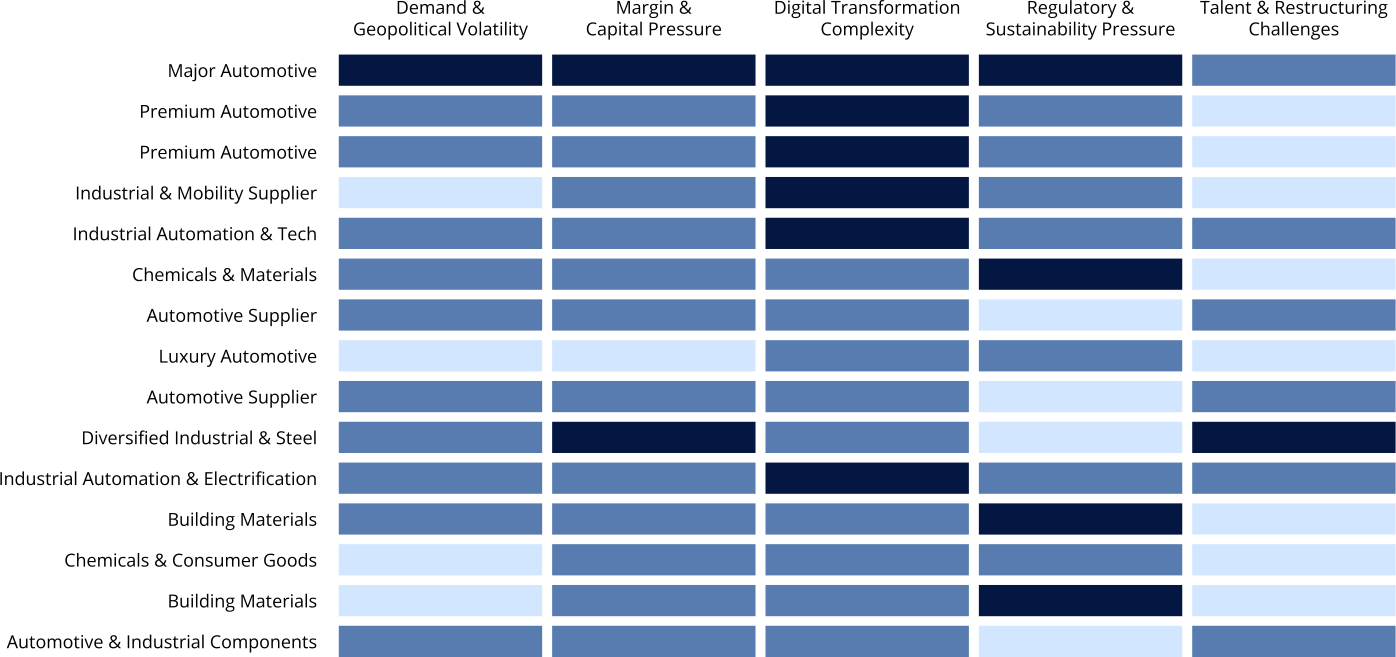
Figure 2: Heat Map of Top 5 Challenges by Sector
This highlights a divide in how AI investments create value – potentially forfeiting early-mover advantages. Asset-heavy companies in DACH are facing a situation where they may miss out on learnings from previous mistakes in peer industries. They could be using this moment as an opportunity to be proactive, bold and, ultimately, more responsible.
How Enterprises Can Take the Responsible Path
The German manufacturing industry is not alone in these challenges. It is uniquely placed to make this blind spot visible for others. Enterprises across industries and regions should take note. As you embark on your investments into AI, consider these three key facets:
Keep AI initiatives and use cases as close as possible to the core organizational strategy and identity. Organizations should ask the following questions:
Is AI really the answer to everything or are there more efficient alternatives for certain transformations?
Is there a clear-cut alignment between the AI initiatives and our stated strategic priorities (e.g., operational excellence or customer intimacy)?
Which internal strengths should we enhance and in what areas should we partner with other organizations?
Make sure AI Investments span the entire value chain and directly contribute to enterprise aspirations, including financial, resource, talent and time. Some questions to ask:
Are we removing friction across the entire value chain – supply chain, employees, customer and clients?
Which parts of our business can AI enhance most meaningfully – design, production, service or UX?
Are the energy investments for the AI use case worth the outcomes/is the ROI verifiable?
Do we have the metrics framework in place to evaluate the initiatives financially and otherwise?
How are we including and co-creating this future with our internal employees and future talent?
Focus on the car rather than the faster horse and take the initiative. The competitiveness and longevity of any company depend on bold leadership as much as correct technology choices. Some questions to ask:
If we start from zero, how would we design our business model around AI and data – not just integrate them into existing structures? How do we define the autonomous enterprise of the future?
Can we identify high-impact niches where we could set an industry standard?
Are we investing in isolated projects or do we have a holistic strategy?
What legacy do we want to leave as a leader in shaping how industrial Europe embraces AI?
ISG helps enterprises across industries unlock the insights they need to accelerate AI adoption and maximize ROI across their organization. We can help you design scalable, compliant and impactful AI strategies and adoption roadmaps. We do not just know AI, we know how to make AI work inside complex, regulated, real-world environments. Contact us to get the conversation started.
Please fill out this form to continue.
About the authors

Dr. Dorotea Baljević