Advisory

Emerging Technology Consulting

Empowering your business to harness emerging technologies and optimize innovation budgets.

TopBar emerging technology solutions visualized as digital vector planet BottomBar
Top Story

State of Enterprise AI Adoption 2025

Get deep AI adoption and market data, including what enterprises are trying, where they are getting value and what our findings suggest about the best practices needed to increase adoption, scale and return on investment.

Read more

Innovation & Long-term Growth Continues Despite Market Conditions

Optimizing innovation and emerging technology resources is critical. 

Hundreds of millions of dollars being spent to gain an understanding of how emerging technologies will impact enterprise business models. You might be asking:

  • Are we innovating enough to remain relevant?
  • What are we missing when it comes to new technologies?
  • How can we optimize our emerging technology strategy?
  • How will our enterprise business models be impacted by emerging technologies?
  • Which emerging technologies should we focus on?
  • Are we being left behind by our competitors? If so, where should we invest?

ISG helps you realize emerging technology transformations:

We help your enterprise with:

  • Understanding the market landscape of emerging technology providers and capabilities
  • Strategizing continuous innovation while concurrently optimizing resources
  • Modeling operational impacts of highly disruptive emerging technologies
  • Aligning business value requirements with emerging technology investments
  • Shaping preparedness plans to prioritize and manage emerging technology pilots 

Leveraging today's burning platforms:

We connect enterprises, technology providers and emerging tech with sourcing, operating model and deep technology expertise, helping you build a strategy to achieve tangible business results from your innovation initiatives.

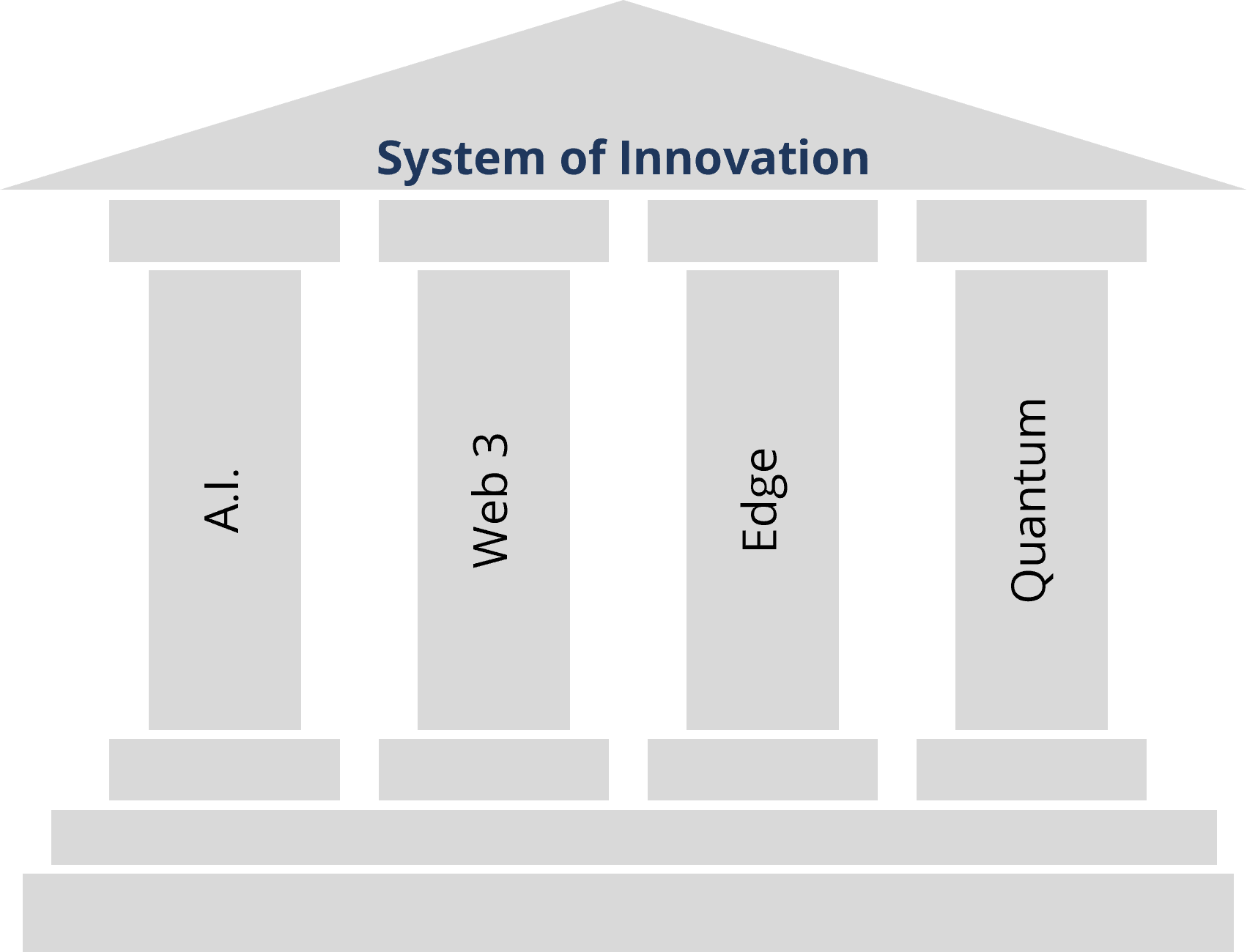
emerging technology and innovation - edge, quantum, ai, web3

Somewhere, someone is innovating – we help you meet them and build a rigorous emerging technologies strategy.

Contact Us

We help tech providers with:

  • Sourcing lighter-weight emerging technology capabilities
  • Developing differentiating and purpose-built enterprise solutions
  • Communicating value propositions for specific emerging technology capabilities
  • Translating emerging technology investments into realizable business value
  • Shape methodologies to support market interest and demand

Defining our technology focus:

In sharp contrast to today’s hype cycle, ISG helps businesses take action in pursuit of business fundamentals. We help enterprises strategically shape tomorrow's operating model to achieve innovation measurable via business results. We focus on 4 key pillars of emerging technologies:

technology

AI

Human-centered AI

An approach to designing and developing AI systems that prioritize the needs, capabilities and perspectives of human users.

Generative AI

A large language model developed by OpenAI that is designed to generate human-like responses to text-based prompts.

Digital Twins

Virtual replicas of physical objects, processes or systems that are used to simulate and analyze their behavior in a digital environment.

technology

Web 3

Metaverse

A hypothetical future iteration of the internet that is a fully-immersive and interactive virtual world. The digital avatars can interact with each other and their surroundings in real-time.

Smart Contracts

Self-executing contracts that automatically execute the terms of an agreement when certain conditions are met.

Decentralized Apps

Applications that run on decentralized networks, such as blockchain, rather than on centralized servers.

technology

Quantum

Quantum Computing

Principles of computer science, physics and mathematics that uses quantum mechanics to solve complex problems faster than on classical computers. 

Quantum Communications

A method of transmitting information securely using quantum mechanics. Quantum communication uses the properties of individual particles such as photons, to transmit information.

Quantum Sensing

An advanced sensor technology that vastly improves the accuracy of how we measure, navigate, study, explore, see and interact with the world around us by sensing changes in motion and electric and magnetic fields. 

technology

Edge

Edge Computer Vision

The use of computer vision algorithms and techniques on edge devices that are capable of processing data locally without relying on a centralized server or cloud computing infrastructure.

Edge Analytics

It involves analyzing data in real-time on local devices or edge servers. This can help to identify patterns and insights more quickly, enabling faster decision-making.

Edge IoT

IoT devices that process data at the edge of the network, rather than sending all data to the cloud. Devices include sensors, gateways and edge servers that perform analytics and decision-making functions.

Answer Your Most Crucial Questions:

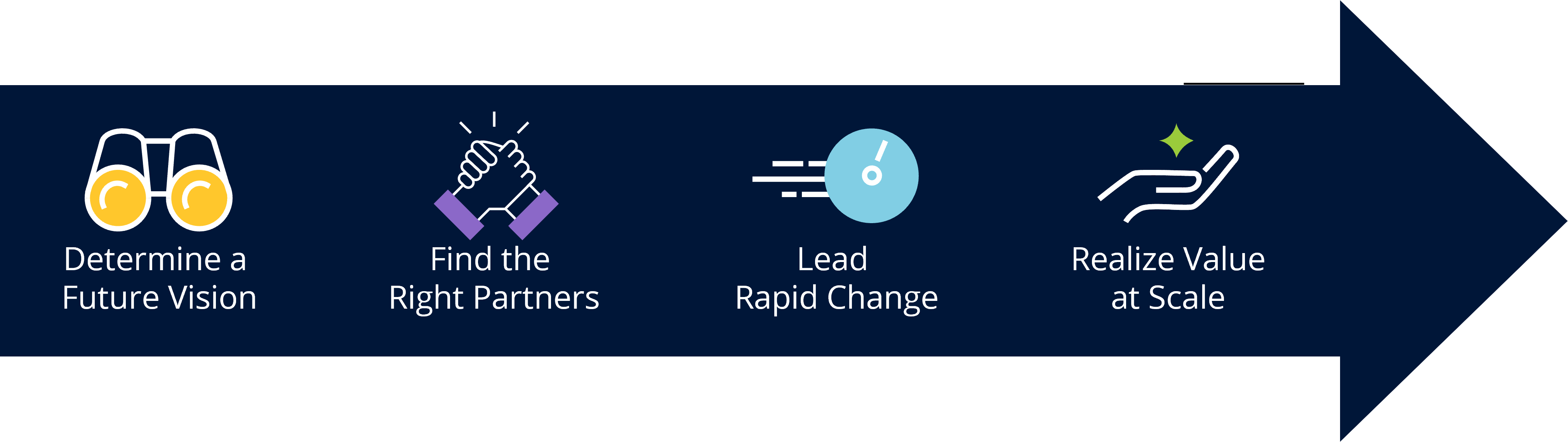
arrow with determining future vision, find the right partners, lead rapid change and realize value at scale on it
  • How do I create awareness within my enterprise on emerging technology beyond the market hype?
  • What are examples and use-cases adopted by firms like mine?
  • What components of my business are impacted by emerging technology and how do I plan ahead?
  • What technologies will drive my firm’s success and who has experience with them?
  • How do I determine what my company should be doing now?
  • What new risks are coming that my firm needs to be ready for?
  • Can I do it myself or do I need help?
  • Who is the right partner(s) to help with the strategy?
  • Who is the right partner(s) to help with the execution?
  • Which engagement models and contractual frameworks should I use to create a partnership ecosystem?
  • Are my employees ready?
  • Are my customers ready?
  • How do I get my organization ready?
  • What business outcomes should I expect from an emerging technology strategy – both internally and externally?
  • How do I measure these outcomes and ensure ongoing value realization?

The market has moved from ambition to accountability.

AI investment is accelerating, but results remain uneven. Only one in four initiatives is meeting revenue impact expectations, at an average spend of $1.3M per use case. Enterprises are no longer asking whether AI works. They are being asked to prove that it pays.

What We Deliver

AI strategy, governance and intelligence, built for execution.

Autonomous Enterprise

Operations built for autonomous execution, not retrofitted for it.

We help you identify where AI agents deliver the most value, restructure workflows around them and build the accountability models that keep autonomous execution auditable. The enterprises that win won't be the ones that reacted. They'll be the ones that designed for it first.

Contact Us
Autonomy-Level Pricing

Pricing that reflects how AI-enabled services are actually delivered.

We give enterprises transparent, benchmarkable pricing models that tag each resource unit with the autonomy level used to deliver it. As AI capability advances, your pricing keeps pace. Both buyers and providers can quantify what that progress is worth.

Contact Us
AI & Software Intelligence

Build-versus-buy decisions grounded in what AI is actually delivering.

We bring analysis of more than $2.6 billion in tracked AI spend to every sourcing decision. Procurement, technology and finance leaders get the independent intelligence to rationalize vendor portfolios and hold providers accountable to measurable outcomes.

Contact Us
AI Governance

Governance that accelerates AI adoption rather than constraining it.

We embed controls at the point of data creation, define accountability for autonomous actions and build adaptive frameworks that keep pace with AI without impeding it. Enterprises that get this right don't just manage risk. They build the trust that lets them scale faster.

Contact Us
AI Strategy

AI investment aligned to where impact is most achievable.

We ground strategy in research across 2,400 enterprise use cases, aligning investment to where impact is proven and designing the data, talent and governance foundations that move AI from pilots into the workflows that drive commercial results.

Contact Us
AI Maturity Index

A clear view of where you stand and a roadmap to where AI starts delivering.

We benchmark your AI readiness against peers across 75 countries, identify the dimensions holding you back and give you a personalized roadmap to close the gap.

Learn More
The market today

Enterprise AI has moved out of IT and into the revenue line.

AI investment is shifting decisively toward revenue-generating functions. CRM automation, sales enablement and forecasting have replaced chatbots and IT productivity tools as the leading use case priorities, reflecting enterprise recognition that productivity gains alone do not satisfy board-level scrutiny. At the same time, use cases in production have doubled since 2024, and the portfolio is diversifying rapidly, with over 300 distinct function and industry-specific use cases now in active deployment.

ISG research across 2,400 enterprise use cases shows that the strongest AI returns are currently concentrated in compliance, risk management and quality control, not in the growth and cost outcomes most enterprises originally set out to achieve

The gap between where enterprises are investing and where AI is actually delivering is the defining commercial tension of 2025. Organizations that close it by targeting functions with structured, revenue-attributable data and clear ROI measures will establish performance benchmarks that compress the window for competitors still cycling through pilots. The standard is being set now.

Where enterprises are feeling the pressure
  • Business outcomes are lagging AI ambition
    Enterprises are scaling Al faster than they are realizing value from it. The number of use cases in production doubled between 2024 and 2025, yet only one in four initiatives is meeting revenue impact expectations, and broad cost savings remain elusive. At an average spend of $1.3M per use case, the ROI gap is sharpening board-level scrutiny and forcing a harder question: are we building Al for impact, or for activity?
  • Data infrastructure exposing deferred investment
    Al does fail in isolation. It fails on the foundations beneath it. Most enterprises are running modern Al on architectures built for reporting and compliance. Generative and agentic Al demand real-time contextually rich, governed data at the point of use. Without it, pilots stall and value dissipate before it reaches the business.
  • The barrier to scale is organizational, not technical
    Organizational readiness as the bigger constraint on Al adoption, not talent or tooling. Workflows haven't been redesigned. Decision rights haven't shifted. Enterprises that treat Al as a pure technology deployment, without investing in the human side of adoption, consistently report underwhelming ROI.
  • Agentic AI is outpacing governance
    As Al moves from generating outputs to executing tasks autonomously, the governance gap widens. Agentic Systems introduce a new class of risk that static compliance frameworks were never designed to catch. Governing what Al does, not just what it produces, is now a business-critical requirement.

Client Stories

Client Stories

Featured Event

Future Workplace Summit

Work is Being Redesigned: Trust, talent and leadership are the hard parts.

Register now

Meet our team