

AI Success Is Not a Technology Issue: It’s an Organizational One
Most organizations enter the AI era believing that once the tools are implemented and have gone live, transformation will naturally follow. In practice, the opposite is true. Technology is not the constraint: organizational readiness is. AI has never been more accessible, powerful or intuitive, and yet adoption remains slow because companies have not established the internal change management they need to support it.
What do enterprises need to accelerate AI adoption? Clear standards, transparent governance and a culture in which employees feel confident and accountable using AI. Without these foundations, even the best tools stall. What emerges instead are disconnected experiments and the dreaded “AI sprawl.” This is when you have a chatbot operating in one team, an automation pilot in another and no enterprise-wide traction. The result is activity that lacks direction and real impact.
In this way, AI functions much like a compass: a remarkably useful tool but only if you know how to use it, have a map and know which direction you want to go. A compass itself cannot tell you where you are or where you want to go or how to properly use it. Once you know these things, a compass will help you find the right path to reaching your goals.
AI technology is similar. Without an understanding of where your organization is today, where it wants to go in the future or the skills to use it, AI tools may be operating, but they will not help you leap forward.
The ISG State of Enterprise AI Adoption report makes it clear that a majority of executives now view AI as core to business success rather than a peripheral technology initiative. Conducted in 2025, the study shows that the C-suite primarily measures the success of AI through three business outcomes: cost savings, productivity gains and revenue growth. The implication is unambiguous: leaders across technology, data, digital and operations have a strong conviction in AI’s value, but organizational readiness is what determines whether that value is realized.
Real success with AI demands a shift in how people think, work and collaborate. It requires direction, new skills, new behaviors and a cross-functional way of operating that breaks traditional boundaries between business, IT, data and leadership. It also requires deliberate strategic focus: companies must identify where AI is genuinely relevant to their business strategy and where it can create differentiated value, improve outcomes and advance core priorities.
AI is not a plug-in but a cultural pivot. If organizations want AI to work for them, they must first prepare their leadership and people to work with AI.
The AI Maturity Gap: Why Organizations Get Stuck
Despite enormous enthusiasm for AI, most organizations remain stuck in early maturity. They experiment eagerly, but they struggle to enhance effectiveness and scale their solutions. The pattern is consistent: decentralized initiatives, inconsistent approaches and the lack of shared standards, direction or strategy to unite efforts.
At the same time, investment momentum is clearly building. According to the ISG Market Lens’ 2026 IT Budgets and Spending Study, 77% of organizations plan to increase IT spending, with 41% saying they will “start new strategic programs of work” and 26% saying they will “accelerate existing strategic programs.” In other words, companies are not pulling back; they are doubling down on AI-led transformation.
Yet these investments often fail to translate into enterprise impact. The ISG State of the Agentic AI Market Report finds that organizational and data readiness remain the dominant barriers to AI value. Most companies are experimenting with generative and agentic AI, but most are struggling to see meaningful results because their data is not fit for dynamic decision-making and their operating models were never designed for AI-level decision velocity.
This creates a familiar paradox: heavy investment with limited enterprise-level impact. Leaders ask for acceleration but lack their own vision and direction as well as visibility into risks, readiness or capability gaps. Teams innovate in silos, often duplicating work or solving the same problems differently. Employees hesitate because they don’t know what’s allowed or if it aligns to organizational aspirations.
This is not a technology failure. It’s an alignment failure.
True AI maturity requires coordinated action: shared guardrails, clear ownership and a strategic framework that connects experimentation with long-term value. Without this foundation, organizations accumulate impressive demos but do not create transformative capabilities.
Closing the maturity gap is a leadership responsibility and a change management challenge.
Please fill out this form to continue.
The Path to AI-Enabled Organization: 5 Phases of AI Maturity
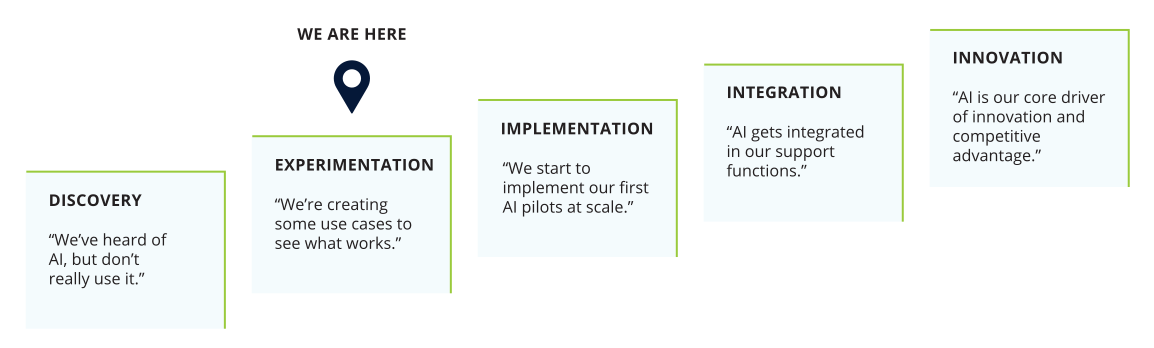
Becoming an AI-first organization is not an overnight leap. It is a deliberate and stepwise progression. Every organization moves through recognizable phases, each building the foundation for the next.
Discovery: Exploring Possibilities
In this phase, there is minimal or no AI adoption and no dedicated AI human resources or AI governance. Employees try genAI, departments run chatbot trials and early prototypes appear, but efforts are isolated and uncoordinated, limiting impact. Teams test tools, learn fast and surface promising use cases. Curiosity exists, but AI is not yet linked to business value or strategy.Experimentation: Validating What Works
In this phase, individuals experiment with GPTs and develop first use cases. Organizations run structured pilots to identify what works, what doesn’t and why. Early AI enthusiasts uncover risks, dependencies, data gaps and adoption barriers but without shared direction, so learnings stay local. First AI foundation models (e.g., LLMs) are established company-wide, and initial attempts are made at AI governance.Implementation: Scaling with Intent
During the implementation phase, pilot projects in isolated teams/departments begin to scale and the enterprise makes its first hires with AI in mind. Teams are motivated to learn with some experimentation incentivized. AI starts solving real business problems in specific contexts, and pilots help define and formalize guidelines and principles. AI becomes a strategic priority; leadership aligns, governance and decision frameworks are set, and employees get training, standards and support. As the first pilots scale, the enterprise shift is from “trying” to “delivering.”Integration: Operationalizing and Systematizing
During the integration phase, support functions like HR and Finance begin to integrate AI and teams begin to hire AI professionals. The company institutionalizes a learning culture around A. Well-coordinated and managed governance bodies are put in place for AI solutions with off-the-shelf solutions generating measurable, lower-risk value. At the same time, organizations build the prerequisites for custom solutions—data, context, domain expertise, dedicated roles, operational governance and AI-enabled infrastructure—so usage becomes consistent and reliable across the enterprise.Innovation: Embedding AI in the Core Business
In the innovation phase, true maturity is reached when custom AI transforms core processes (e.g., product, operations, manufacturing, sales, service). Dedicated AI talent is embedded in business functions, advanced capabilities are integrated into the technology stack, and enterprise governance is fully established across IT, legal, ethics and risk. As AI gets integrated into strategic core functions and business processes, it is no longer a program, it becomes how the organization operates.
AI Organization Maturity Model
Why OCM Is the Missing Accelerator
Many organizations assume that once AI tools are deployed, adoption will naturally follow. But technology often outpaces the organization's ability to absorb it. Employees question what AI means for their roles. Leaders set ambitious timelines without clarity on risks or readiness. Teams adopt tools inconsistently or not at all.
What to do when technology is ready, but the organization is not? This gap is visible in high-profile AI deployments where the tools worked, but the surrounding organization was unprepared. Global financial technology company Klarna, for example, experienced a rapid shift to AI-driven customer service that, in reality, undermined trust when service models, escalation paths and employee readiness were not adapted in parallel. Similarly, the data analytics division IBM Watson Health struggled not because its AI lacked sophistication, but because its clinicians were not sufficiently involved, workflows were not redesigned and trust in the system never took hold. In both cases, the limiting factor was not the technology but the absence of organizational change management to embed AI into how people actually work.
Organizational change management (OCM) builds trust, creates clarity and guides people into new ways of working. It provides communication, capability-building and alignment needed to make AI adoption both responsible and sustainable.
OCM ensures:
Trust before technology: People adopt what they understand. Transparent communication and visible support create the psychological safety needed for experimentation.
Capability before complexity: AI requires new skills. Structured training, simple guidelines and hands-on enablement make adoption achievable for everyone.
Alignment before acceleration: Shared standards and governance ensure that innovation scales in the right direction, not in parallel silos.
With OCM, AI evolves from isolated pilots into a coordinated, enterprise-wide movement. It turns uncertainty into confidence and potential into competitive advantage and sustained value.
The OCM Playbook for AI: What Actually Works
Introducing AI to an organization isn’t about the tool – it’s about the change. The most successful transitions and transformations follow a practical OCM playbook that guides people step by step into new ways of working.
Organizational Change Management Measures and Benefits for AI Adoption
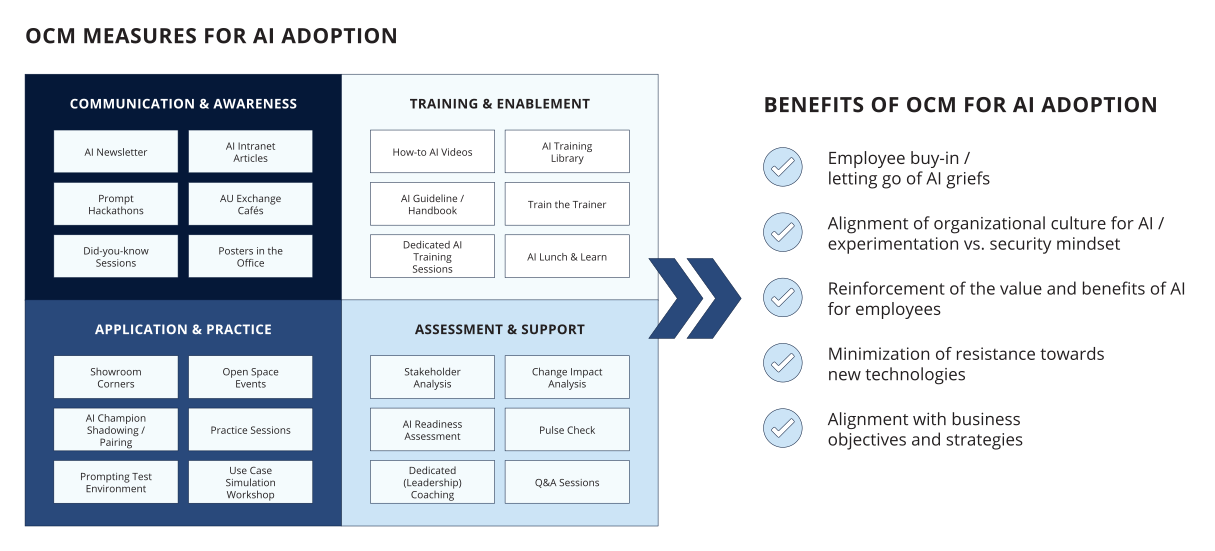
An OCM playbook for AI provides a means to:
Raise awareness by making AI visible, approachable and relevant
Build understanding by providing simple entry points and real examples of AI in action.
Establish trust by understanding sentiment and readiness.
Reinforce and sustain by building communities of practice that keep momentum alive.
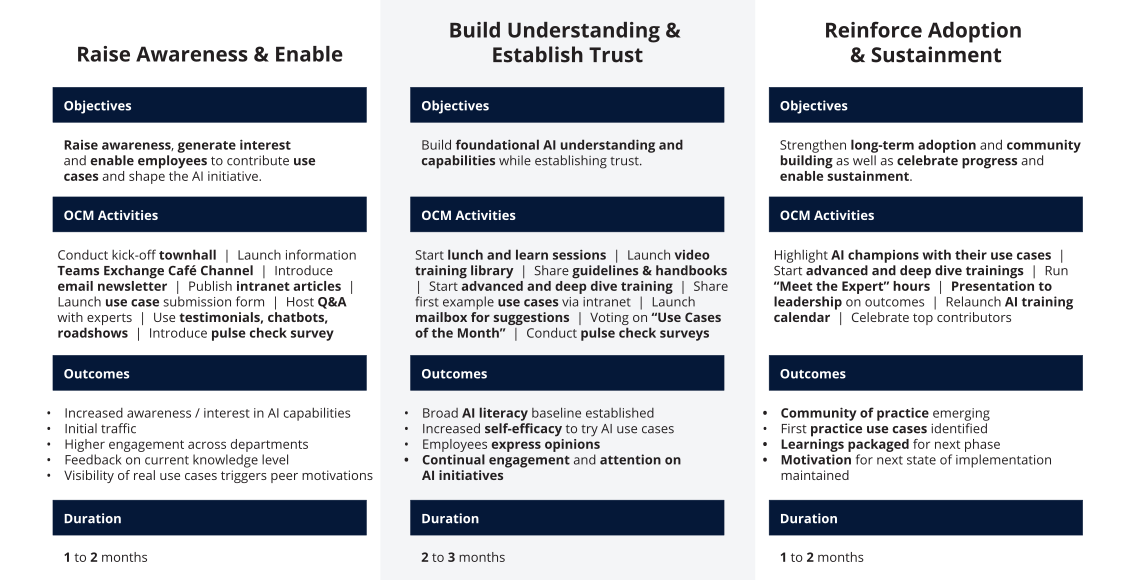
OCM is critical at each of the five stages of the AI Maturity Model. For example, the goals of the experimentation stage are threefold: to raise awareness, generate interest and enable employees to contribute use cases and shape the AI initiative.
OCM Activities to Achieve Goals of the Experimentation Phase
The following activities will help achieve the objectives specific to the experimentation phase:
AI Excellence Requires Change Excellence
The promise of AI is enormous: efficiency, creativity, smarter decisions and new ways to create value. But none of it becomes real without people. Their willingness to learn, adapt and embrace new ways of working determines whether AI becomes a strategic asset or another stalled initiative. OCM provides the structure, clarity and cultural foundation needed to unlock AI’s potential. It aligns leadership, empowers employees and turns individual experiments into enterprise capability.
AI is not a shortcut. It is a capability built over time: one behavior, one decision, one use case at a time. Organizations that invest in change as deliberately as they invest in technology will move faster, scale smarter and stay ahead.
What You Should Do Next
Becoming an AI-first organization starts with clarity on where you stand and where you want to go. Begin by assessing your current stage in the AI Maturity Model to create a shared understanding across the organization. Once you know your baseline, prioritize the strategic focus areas and use cases that will deliver the most impact over the next six to 12 months grounded in your data, your capabilities and your business goals. Finally, mobilize to translate these insights into action and build momentum through targeted initiatives, supported by the right communication, upskilling and change management structures.
And, if you want a partner to validate your ideas, refine your roadmap or explore the OCM tools and methods that make AI adoption truly work, feel free to reach out. ISG helps enterprises around the world make the most of their investments and accelerate their AI journey.
About the authors

Anna Bücking